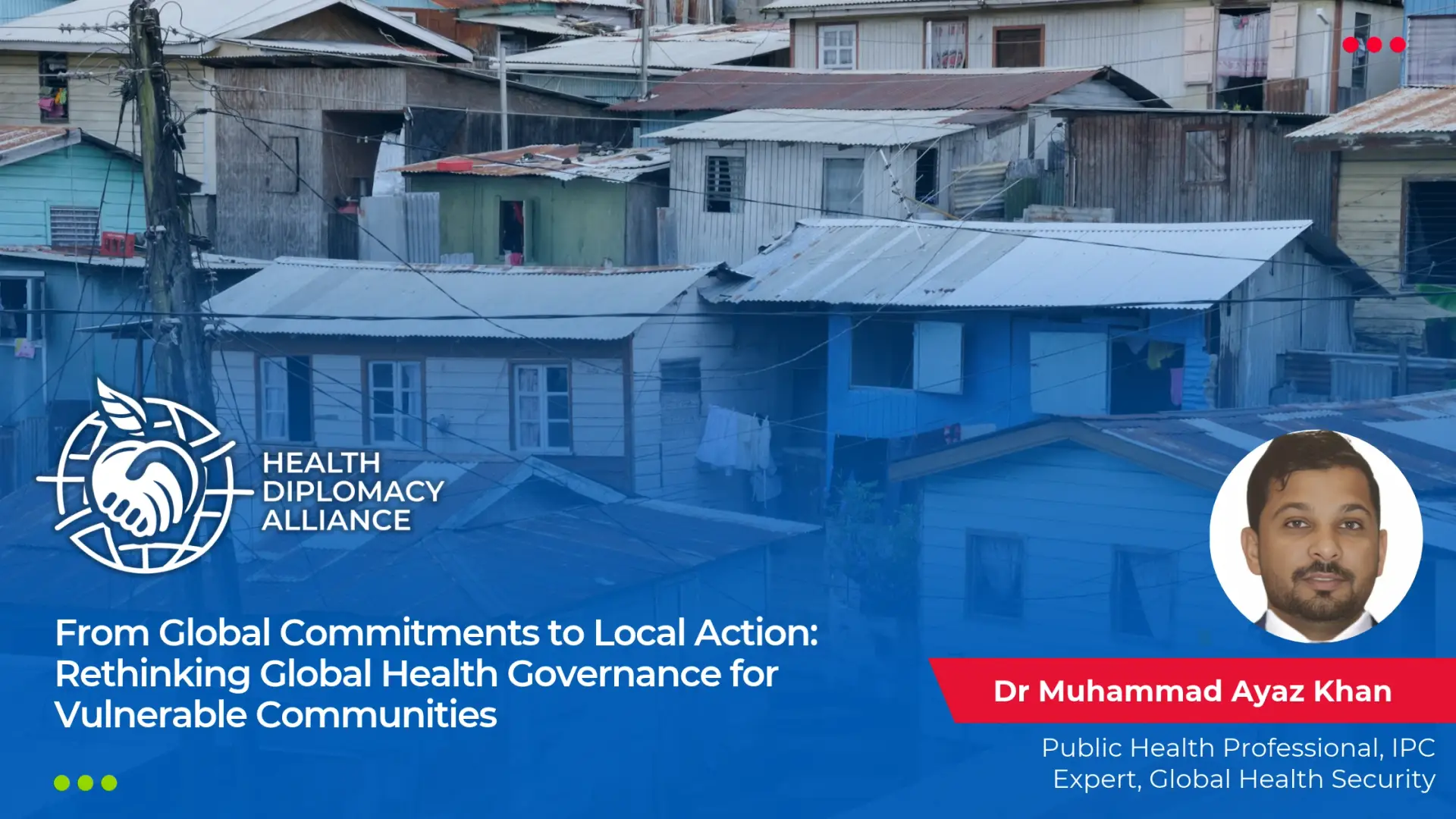
Global Health Promises Mean Little Until They Reach Local Communities
The world does not suffer from a shortage of health commitments. We have international agreements, strategies and declarations addressing epidemics, antimicrobial resistance, climate change and health equity. Yet for a patient entering an under-resourced hospital—or a family displaced by flooding—the real question is much simpler: what has changed?
Can the hospital prevent an avoidable infection? Will an outbreak be detected early? Can a community receive timely care when an emergency strikes? These are the tests that matter.
The discussions at the Health Diplomacy Alliance’s NYC Climate Week event, “A Changing Global Health Architecture and the Governance of Climate-Health,” brought this challenge into focus for me. Drawing on my work at Pakistan’s National Institutes of Health (NIH), I see a central task for global health diplomacy: connecting international ambition with the people, systems and resources required to deliver results locally.
The gap between signing an agreement and changing a system
Global frameworks are essential. The International Health Regulations (2005), for instance, provide a shared basis for countries to detect, assess, notify and respond to public health risks with potential international consequences [1]. But an agreement cannot, by itself, train a surveillance officer, equip a laboratory or sustain an infection prevention programme.
Implementation requires more than endorsement. It requires a funded plan, clearly assigned responsibilities, skilled workers, reliable information, coordination across institutions and a way to measure whether services are improving.
For resource-constrained countries, this gap is particularly consequential. International expectations may grow faster than domestic capacity. Global partners can help close that gap—not through parallel projects that disappear when funding ends, but by supporting national institutions to own, finance and sustain essential functions.
What infection prevention and surveillance taught me
At NIH Pakistan, my work has involved infection prevention and control (IPC), healthcare-associated infection (HAI) surveillance and national strategic planning. These may sound like specialized technical areas, but their importance is immediate: an infection acquired during treatment can prolong illness, increase costs, threaten healthcare workers and contribute to antimicrobial resistance. WHO’s Global Report on Infection Prevention and Control 2024 reinforces the need for effective IPC at both national and facility levels [2].
A strategy becomes meaningful when a hospital has trained personnel, an active IPC committee, essential supplies, consistent surveillance definitions and a clear process for acting on infection data. Otherwise, a plan may look comprehensive on paper while everyday practice changes very little.
The same principle applies to digital health. I have also worked on digital approaches to HAI surveillance, including demonstrating a DHIS2-based tool. Such systems can make patterns visible and strengthen reporting. But a dashboard does not improve patient safety unless the underlying data are trustworthy and someone has the authority and resources to respond.
The value of surveillance is not in the number of reports produced, but in the infections prevented and the decisions improved.
One Health must become a way of working, not just a slogan
Outbreak preparedness does not end at the hospital door. Human, animal and environmental health are connected through zoonotic diseases, antimicrobial resistance, food systems and ecological change. That is why the One Health approach matters.
The One Health Joint Plan of Action 2022–2026, developed by WHO, FAO, UNEP and WOAH, promotes coordinated action across sectors [5]. Translating this into practice means agreeing who shares what information, how emerging threats are escalated, which institutions lead a response, and how joint exercises and capacities will be financed.
Strong IPC and HAI surveillance can reinforce the human-health component of this wider agenda. But they need to be connected with veterinary services, environmental agencies, laboratories and emergency-response structures. Cooperation cannot depend only on personal relationships or ad hoc meetings; it needs routine institutional arrangements.
Climate resilience and equity: who is protected first?
Climate-related health threats make the implementation challenge even sharper. Floods, extreme heat, water insecurity and interruptions to essential services do not affect everyone equally. People already facing poverty, displacement and limited access to healthcare often have the fewest resources to recover.
For Pakistan, climate-health governance should therefore be judged by practical preparedness: can health facilities continue functioning during floods or heatwaves? Can surveillance identify emerging risks? Are response plans designed for remote and underserved communities? Do frontline workers and affected populations have a voice in how resources are allocated?
Equity is not simply a principle to mention in policy statements. It should influence where investments go, which risks are monitored and whose outcomes are used to judge success.
Three changes that would make global health governance more effective
- Put national ownership at the centre. Support countries to set priorities, assign institutional responsibilities and build long-term capability, rather than creating short-lived parallel arrangements.
- Finance the foundations of preparedness. Protect sustained investment in IPC, surveillance, laboratories, workforce skills, essential supplies and multisectoral coordination. Digital systems should strengthen—not substitute for—these capabilities.
- Measure implementation, not just commitments. Track whether surveillance information drives action, facilities can prevent infections, institutions respond quickly and vulnerable populations receive better protection. Publish results and use them to improve decisions.
The test of global health diplomacy
International cooperation is indispensable. But its success should not be measured mainly by the number of declarations endorsed, partnerships announced or strategies drafted. Those outputs matter only when they create stronger institutions and safer services.
My experience with IPC, HAI surveillance and strategic planning has reinforced a simple conviction: global health governance succeeds when local systems can act. If health diplomacy helps a facility prevent infections, a surveillance team detect a threat earlier or a flood-affected community access care sooner, then an international commitment has begun to deliver on its promise.
The true measure of global health cooperation is not what we promise on the world stage, but what improves in people’s lives.
Reference and further reading
[1] World Health Organization. International Health Regulations (2005), third edition (2016), with subsequent amendments.
[2] World Health Organization. Global Report on Infection Prevention and Control 2024. Geneva: WHO, 2024.
[3] National Institutes of Health, Pakistan. National Infection Prevention & Control Strategic Plan 2025–2030.
[4] National Institutes of Health, Pakistan. National HAI Surveillance and Response Strategic Plan 2025–2030.
[5] WHO, FAO, UNEP and WOAH. One Health Joint Plan of Action (2022–2026). 2022.