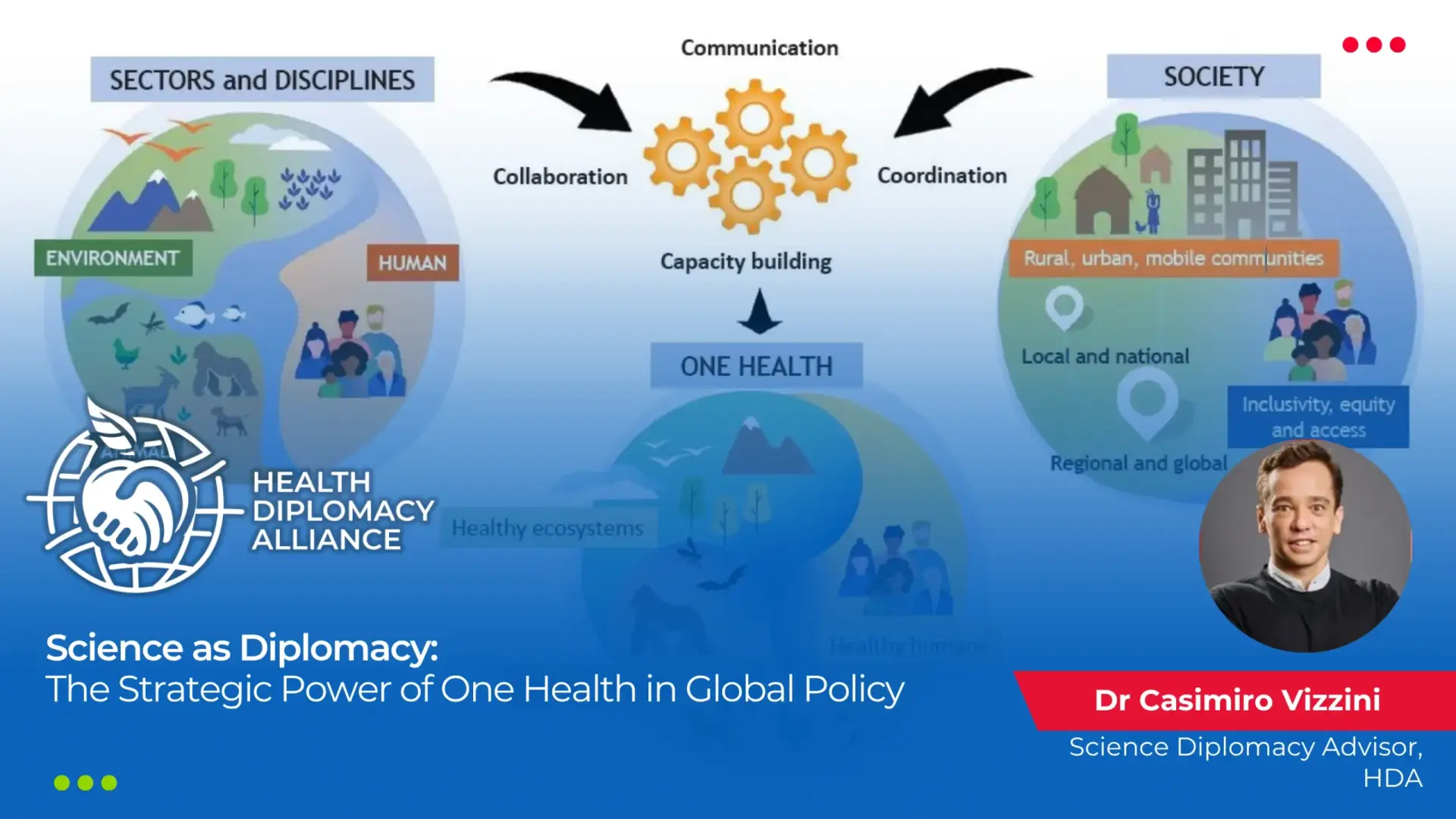
The One Health approach, which recognizes the interdependence of human, animal, and environmental health, is not only a matter of scientific collaboration but also a prime example of Science Diplomacy in action. Science Diplomacy goes beyond cooperation to engage science as a strategic diplomatic tool, capable of influencing global policies, easing geopolitical tensions, and fostering trust between nations with differing agendas. Through this lens, the One Health approach becomes a means of addressing complex and often contentious global challenges by leveraging scientific expertise in diplomatic negotiations, international treaties, and conflict resolution.
The diplomatic role of science becomes evident in how scientific knowledge informs global health policies, mediates disputes, and fosters international trust. For instance, pandemic preparedness is not just about sharing research and data but also about aligning different national interests in a way that can prevent diplomatic rifts during crises. During the COVID-19 pandemic, for example, the distribution of vaccines, access to essential medicines, and the regulation of travel and trade became highly politicized. Scientific expertise, combined with diplomatic negotiation, helped to form frameworks like COVAX that sought to balance national interests with global health equity. This balance required science to be used as a diplomatic instrument, guiding international discussions toward a common understanding of the evidence and creating mutual agreements amidst political tension.
Similarly, global efforts to combat antimicrobial resistance (AMR) highlight the diplomatic weight science carries in policy discussions. AMR is driven by practices in agriculture, healthcare, and environmental management that are influenced by economic interests, political priorities, and social norms in different countries. Here, science provides the common ground upon which diplomatic negotiations occur. Initiatives like the Global Action Plan on Antimicrobial Resistance, developed by WHO, FAO, and WOAH, were not just scientific collaborations but diplomatic triumphs—binding nations to a shared set of guidelines that balanced national sovereignty with the need for collective action. In this case, scientific evidence served as the backbone for treaty-making, where diplomatic negotiations turned scientific consensus into political commitments.
The One Health approach to climate change and environmental degradation similarly exemplifies Science Diplomacy. Environmental health directly impacts national economies, food security, and public health, making it a politically charged issue. Here, science plays a diplomatic role by creating a neutral ground for dialogue between countries that may be at odds on other fronts. The Intergovernmental Panel on Climate Change (IPCC), for example, has been instrumental in shaping the Paris Agreement. Through scientific assessments of climate change’s impact on ecosystems, agriculture, and human health, the IPCC’s work serves as a diplomatic bridge, ensuring that all parties—despite conflicting political or economic interests—base their negotiations on shared scientific understanding. Science thus becomes a tool not just for cooperation but for diplomatic consensus-building, helping to mediate conflicts over resource management, carbon emissions, and environmental responsibility.
In the context of wildlife conservation and zoonotic disease surveillance, Science Diplomacy plays a role in preemptive conflict resolution. Zoonotic diseases, such as Ebola and avian influenza, often emerge from regions with significant biodiversity and sometimes weak governance structures. The risk of diseases spilling over into human populations can become a source of diplomatic tension between neighboring nations or trading partners. Science can act as a diplomatic intermediary by offering objective, evidence-based assessments of the risks and by establishing internationally recognized protocols for disease surveillance. This allows nations to resolve potential conflicts diplomatically before they escalate, with organizations such as the Global Health Security Agenda (GHSA) providing platforms for scientific-diplomatic engagement. Rather than being a purely cooperative effort, this is a strategic use of science to negotiate boundaries, responsibilities, and shared risk.
Food safety and food security provide further examples of the diplomatic role of science. Disputes over food standards, trade, and agricultural practices can create tension between nations, particularly when health and safety regulations differ. Science Diplomacy here is used to harmonize these standards while respecting national sovereignty, thus preventing potential trade wars or diplomatic standoffs. For example, the Codex Alimentarius Commission, a joint effort by WHO and FAO, plays a diplomatic role in mediating disagreements over food safety, using scientific evidence to broker consensus on what constitutes safe food practices. In this capacity, science is not just enabling cooperation but is driving diplomatic negotiation, ensuring that trade disputes do not escalate into larger geopolitical conflicts by grounding them in neutral, scientifically verifiable standards.
In the broader context of environmental issues like biodiversity loss and pollution, science is used to establish common metrics for environmental impact assessments, which then feed into diplomatic negotiations for treaties like the Convention on Biological Diversity or the Montreal Protocol on substances that deplete the ozone layer. Science acts as a form of diplomatic currency in these discussions, allowing countries with divergent interests to engage in constructive dialogue based on mutually understood scientific principles. Diplomatic negotiations often hinge on the interpretation of scientific data, with science providing the means to translate complex environmental challenges into actionable policies, thus preventing potential conflicts over resource use and environmental degradation.
In conclusion, the One Health approach is not just about scientific collaboration; it is a key arena for Science Diplomacy, where science plays a diplomatic role in shaping international policies, mediating disputes, and fostering global trust. By applying scientific principles in diplomatic contexts, nations can navigate the challenges of human, animal, and environmental health with greater clarity and consensus, ultimately leading to more effective and equitable global governance. In this sense, the diplomatic role of science in One Health goes beyond cooperation—it is about using scientific knowledge as a strategic tool to resolve conflicts, negotiate treaties, and build long-term, sustainable relationships between nations.
About the author
A Medical Doctor specializing in Urology, with advanced studies in International Cooperation, he has over 18 years of experience bridging science, health, and diplomacy. His career spans roles at UNESCO, where he led science policy and capacity-building projects, collaborated with the AAAS on science diplomacy, and secured European Commission funding for global partnerships. As Secretary General of EUGLOH, he advanced academic collaboration in global health, and currently, at OSH, he promotes sustainable One Health strategies, and at HDA, where he works on Science Diplomacy. His multidisciplinary expertise integrates clinical knowledge with international relations to address global health challenges through institutional and cross-sectoral collaboration.