“We built the architecture for AMR governance; now we must fund it, measure it and open it to civil society. Prevention can help pay for itself, on farms and in clinics. From penicillin to new antibiotics, the test is access: medicines made for public purpose, reaching everyone who needs them.”
By Anthony D. So, MD, MPA | Emeritus Distinguished Professor of the Practice, Johns Hopkins Bloomberg School of Public Health
You co-convened the UN Interagency Coordination Group, whose recommendations went to the Secretary-General in 2019. Looking at the 2024 Political Declaration and the updated Global Action Plan, which of those recommendations have been taken up, and which are still missing?
Perhaps the IACG’s most visible legacy is the global architecture for AMR governance we proposed. The Global Leaders Group, the Multi-Stakeholder Partnership Platform, the Quadripartite Joint Secretariat and now the Independent Panel all trace back to its recommendations. That is a real accomplishment. But each has been asked to do much with so little. In the Abuja Compact, Member States should commit to a public dashboard that tracks the resources and staffing that each of the Quadripartite agencies commits to tackling antimicrobial resistance.
Meanwhile, declaration after declaration has become a Christmas tree, each constituency hanging its own ornament. Few offer tangible, measurable commitments. Some countries have renewed their National Action Plans on AMR, still without financing, and the share with dedicated domestic funding has stagnated at around 10 percent.
Since 2019, the Antimicrobial Resistance Multi-Partner Trust Fund has attracted less than US$60 million in commitments. Yet the case for investment was made long ago. In 2018, the OECD’s modeling across 33 OECD and EU countries suggested that measures costing about US$2 per person a year could pay for themselves within a year and save up to 1.6 million lives by 2050. In 2017, the World Bank modeled an investment of about US$9 billion a year in AMR containment in low- and middle-income countries. If it averted even half of AMR’s economic toll, that investment would yield US$10–27 trillion in cumulative benefits by 2050, with the largest gains flowing to the upper-middle- and high-income countries best positioned to make it. The choice is to pay now, or pay much more later.
Accountability also needs measures. The IACG set out to explore the feasibility of global goals and targets. It stopped short of setting them but called for shared targets to be developed, and some of us hoped its framework would be built upon with benchmarks to mark progress over time. A plan that cannot be graded cannot be held to account. The 2024 Political Declaration took such a step, committing to cut deaths associated with bacterial AMR by 10 percent by 2030 and setting targets for Access antibiotics, laboratory testing and funded national plans. The Global Action Plan (GAP) should become a measurable Global Plan of Action (GPA).
Finally, none of this moves without civil society. The IACG called for political, financial and technical support for civil society, while preserving its independence. It is time to act on this recommendation. The WHO Civil Society Task Force on AMR is beginning to show what organized civil society can bring to this work. Enlisting and resourcing civil society is how commitments become change.
You have long argued that new antibiotics need business models that share resources, risks and rewards. Where do current pull incentives fall short on access, especially for low- and middle-income countries?
Pull incentives pay for the outputs of R&D. By design, they favor firms that can afford to run the race, not the small firms doing the early-stage work of discovering novel classes of antimicrobials. As WHO’s analyses of the antibacterial pipeline have repeatedly documented, small firms carry most of that pipeline. Public and philanthropic funders already shoulder much of the early risk, yet even cumulatively the sums are modest. These push incentives pay for the inputs of R&D, from CARB-X’s awards to drug developers to GARDP’s product development partnership efforts. Over its first decade, CARB-X awarded US$613.6 million while GARDP, launched in 2016, reports cumulative commitments of €260.4 million.
Proposed pull incentives, by contrast, run to billions of dollars. The US PASTEUR Act, reintroduced in Congress in 2026 and still pending, would appropriate US$6 billion. These incentives typically reward developers by bolstering the traditional business model. They are not designed to make the reward conditional on affordable access, appropriate use and reliable supply where need is greatest. The US GAIN Act’s five additional years of market exclusivity attach to any qualifying product, novel or not. By 2017, nearly half of the 147 products the FDA had designated were already-approved drugs being modified, and, as the FDA itself reported, none of the 12 products approved under the Act worked through a new mechanism of action. Subscriptions delink payment from sales only within the country market that pays. Exclusivity-based rewards pay through delayed generic competition: when the European Commission proposed a transferable exclusivity voucher in 2023, it acknowledged that the scheme would transfer its costs to Member States’ health systems by delaying generic entry for the products the vouchers cover. A model that pays more without assuring novelty, and extends access only to those who pay, cannot be the template for the low- and middle-income countries carrying the heaviest burden of drug-resistant infections.
An end-to-end approach can do better. It aligns interventions across the pharmaceutical value chain, from discovery to delivery, so that returns no longer depend on selling more. At the dawn of the antibiotic age, a US government–coordinated effort with industry and academia scaled up wartime production of penicillin. US production rose more than 300-fold, from 21 billion units in 1943 to over 6.8 trillion in 1945, and the price of 100,000 units fell from US$20 in 1943 to under 10 cents by 1949. Today GARDP is assembling parts of such a chain: under a license covering 135 countries, it has sublicensed manufacture of cefiderocol to India’s Orchid Pharma on cost-plus terms, with production facilities still under construction. In the United States, CivicaRx applies the same logic. Hospital systems accounting for more than 30 percent of licensed US hospital beds formed this nonprofit generic drug company. Their purchase commitments guarantee the volumes it needs, so supply is matched to what members need rather than to what maximizes sales. Civica’s first supply contract committed to buying two hospital antibiotics, vancomycin and daptomycin, from Xellia Pharmaceuticals at set volumes and prices over five years.
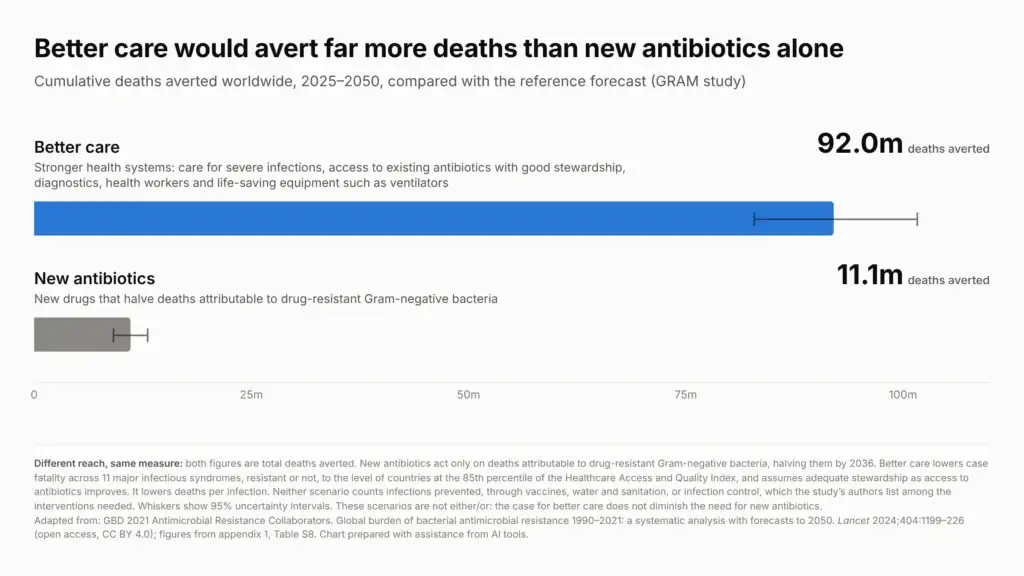
Importantly, opportunity costs set a ceiling on what we should invest in new antibiotics. A fully delinked global pull incentive has been estimated at US$2.2–4.8 billion per novel antibacterial, with a best estimate of US$3.1 billion, to make its development commercially viable. The Lancet’s 2024 GRAM forecast compared two responses to rising AMR deaths through 2050. Bringing new antibiotics to market that halve the burden of Gram-negative infections would avert 11.1 million deaths between 2025 and 2050. Improving health systems instead—better care for severe infections and access to existing antibiotics—would avert five times as many. New antibiotics remain essential. But the larger dividend lies in health systems that deliver, and steward, the antibiotics we already have.

AI is now used to discover new antibiotics and to guide prescribing. How can governments make sure these tools strengthen access and stewardship rather than widen the gap between countries?
Whether AI narrows or widens the gap within or between countries depends on two things beyond the technology itself: the knowledge it learns from and the health systems it enters. Wider safety risks, including the potential to turn these tools toward designing harmful agents, deserve serious attention in their own right. My focus here is narrower: whether its benefits reach the people who need them.
Like telehealth, AI can bring specialist judgment to a bedside where no specialist is available in resource-limited settings. Yet a diagnosis that no one locally can confirm or act on leaves the gap in place. Nor does adoption in wealthy countries guarantee better or lower-cost care. In a recent US study, care plans written by 20 general-purpose language models would have cost about three times what treating physicians ordered, mostly because of tests added where the physician ordered none, and the models recommended specialist referrals nearly six times as often. How AI shifts thresholds for testing and referral matters as much as how accurate it is.
In the discovery of novel antibiotics, AI design choices decide who can make what is discovered. SyntheMol, from Jonathan Stokes and colleagues, builds structurally novel candidates only from commercially available building blocks joined by well-characterized chemical reactions, so each design comes with a recipe for making it. Narrowing the vast chemical space to the drug candidates that are most synthetically tractable could let manufacturers, including those in low- and middle-income countries, scale up a new antibiotic without years of medicinal chemistry work. But the promise depends on who can take part. Cesar de la Fuente-Nunez and colleagues argue for open code, open training and testing data, and open findings. Of the antibiotic-discovery models they reviewed, fewer than a third had released their code. If public funders commit to an open-science framework, academic investigators in every region can contribute, not only private firms.
In stewardship, bias in the data carries into the model. WHO cautions that weaker surveillance systems may draw their data mainly from tertiary hospitals, which could overstate resistance. A prescribing tool trained on such data could push broader-spectrum drugs into primary care. Of 18 studies in a recent systematic review of AI in antimicrobial stewardship, only one came from a low- or middle-income country. WHO’s principle of inclusiveness and equity, and its call to validate tools in the populations where they will be used, seeks to address this. Provider behavior matters too. When rapid malaria tests were introduced in studies across six countries in Africa and Asia, antibiotic prescribing rose by about a fifth, and 69% of patients who tested negative received an antibiotic. None of the training programs gave systematic guidance on managing the other causes of fever. A diagnostic tool, AI-driven or not, that rules one cause out without guiding the next decision may simply shift overuse from one drug class to another.
Finally, tools must reach the base of the health care pyramid. MSF’s Antibiogo, a smartphone app that reads antibiotic susceptibility tests, and its Mini-Lab, a transportable laboratory run by non-specialist staff, are built to do that. Where equipment cannot be placed locally, specimen transport sets the pace. In one primary care clinic study in Johannesburg, running the Xpert TB test at the point of care rather than in an off-site referral laboratory cut median time to initiating treatment from five days to zero for patients who tested positive. The 2024 Political Declaration’s goal that 80% of countries can test for resistance across all GLASS pathogens by 2030 depends on ensuring that last mile access.
Your video case studies with FAO, including on farmer field schools, showed that better animal husbandry can reduce the need for antimicrobials. What would it take to scale this approach, and who should pay for it?
Reducing antimicrobial use in food production works best when incentives are aligned so that farmers’ livelihoods are sustained, not sacrificed. With FAO support, we documented three such approaches in video case studies. In Zambia, farmer field schools train poultry farmers in husbandry practices that replace routine antibiotic use. In Indonesia, three-zone biosecurity divides farms into high-, medium- and low-risk areas to keep infections out. An FAO study found these practices reduced antibiotic use on layer farms by up to 40 percent, and they also help farms earn the national food-safety certification that opens higher-value markets. In Ecuador, the Sustainable Shrimp Partnership requires member farms to use zero antibiotics, verified through inspections during each production cycle. Member farms receive blockchain verification of their zero-antibiotic use that traces their shrimp product from farm to fork.
Prevention can help pay for itself. In a two-year FAO study, small broiler farms that adopted low-cost biosecurity and management improvements gained about US$75 per 1,000 birds per production cycle relative to comparison farms, after covering the improvements’ cost. How much of that reaches farmers, however, depends on their contracts with integrator companies. Farmers also bear the upfront costs, which weigh most on smallholders. From 2015 to 2017, successive Chain Reaction reports graded the 25 largest US restaurant chains on antibiotic use in their meat supply. The number earning passing grades rose from five to nine to fourteen, although progress came largely in poultry.
Market signals like these depend on credible monitoring. The Muscat Manifesto set a target to reduce antimicrobial use in agrifood systems by at least 30–50 percent by 2030, and the 2024 Political Declaration pledges a meaningful reduction. Yet only 38 of the 111 countries reporting quantities to WOAH publish a national report, a number that has barely moved in nine years. More have recently opened their data through WOAH’s ANIMUSE database, but only 39 of 183 Members had done so as of January 2025. Without public country-level data, we cannot hold countries to their commitments, and markets cannot reward the producers who meet them. The Abuja Compact could ask every country to publish what it reports.
Who should pay? Producers and buyers who capture the returns should share the costs. But veterinary services, vaccination and agricultural extension services that train and advise farmers are public goods, and the 2024 Political Declaration commits governments to invest in animal health systems, including essential veterinary services, vaccines and management practices that prevent infections (¶73). The money exists. FAO, UNDP and UNEP found in 2021 that 87 percent of the roughly US$540 billion in annual support to agricultural producers is price distorting or harmful to nature and health. Repurposing even a small share toward prevention would sustain farmers’ livelihoods while delivering co-benefits for addressing AMR.
Shortages of old, essential antibiotics such as penicillin keep recurring, even though they are cheap and off patent. Why does the market fail to supply them, and what should governments do about it?
Penicillins remain the backbone of essential antibiotic care, from oral amoxicillin, first choice for most common primary-care infections, to injectable ampicillin or benzylpenicillin for newborns with sepsis and benzathine penicillin G for syphilis and rheumatic heart disease. When stockouts or shortages occur, the toll falls on mothers, newborns and children. WHO estimates 700,000 cases of congenital syphilis in 2022, causing 390,000 stillbirths, newborn deaths and other adverse birth outcomes; benzathine penicillin G is the recommended treatment to prevent transmission in pregnancy. An estimated 55 million people live with rheumatic heart disease, and many depend on injections every three to four weeks, for years, to keep it from progressing. Nor is the Global North spared. The United States has faced a shortage of benzathine penicillin G since April 2023, deepened by a 2025 recall, while congenital syphilis rose for a twelfth consecutive year, to nearly 4,000 cases in 2024. Each gap pushes prescribers toward broader-spectrum substitutes, which can contribute to AMR.
Penicillins earn low returns compared with more lucrative pharmaceutical products, so investment flows elsewhere. Fragmented purchasing compounds the problem: demand split across many formulations, strengths and presentations and bought through separate national tenders leaves each production line with thin, unpredictable volume. Production has consolidated upstream, mostly in China. The only WHO-prequalified benzathine penicillin G comes from a single Spanish manufacturer whose active ingredient is made in China, so disruption of fermentation production in China can have ripple effects in the supply chain worldwide. Raising prices is not the remedy; that would undercut access where need is greatest. Predictable, consolidated demand and public investment in capacity are.
The 2024 Political Declaration recognizes much of this. It asks that pooled procurement and aligned medicine registration be considered (¶45), recognizes the importance of sustained manufacturing of existing antibiotics and of diversified regional capacity (¶81, ¶82), and promotes technology transfer (¶87). Translating recognition into action is the work ahead.
The centenary of Alexander Fleming’s discovery, on 28 September 2028, will rightly celebrate a moment of scientific insight. It is also an occasion to recall what followed: wartime collaboration among government, universities and industry made penicillin in quantity, and after the war WHO and UNICEF helped India build a public plant that by 1958 met about 70% of national consumption. Public purpose, industrial partnership and shared know-how turned a discovery into a medicine for many.
The Global Penicillin Access Campaign of the WHO Civil Society Task Force on AMR aims to mark that date with a public account of penicillin access along the value chain, drawing upstream on global supply chain data and downstream on community-led monitoring of whether clinics have affordable penicillin in stock, and securing commitments to close the gaps it reveals.

Anthony D. So is Emeritus Distinguished Professor of the Practice at the Johns Hopkins Bloomberg School of Public Health and founding director of the IDEA (Innovation+Design Enabling Access) Initiative. He served as Co-Convenor of the UN Interagency Coordination Group on Antimicrobial Resistance, whose recommendations were delivered to the Secretary-General in 2019, and is now on the Steering Committee of the WHO Civil Society Task Force on AMR. He writes on antimicrobial resistance and access to medicines at anthonydso1.substack.com.