“AMR needs a One Health approach across sectors, but also across generations. Prevent AMR now by promoting intergenerational collaboration, building plans together, tracking promises together, and acting together, with youth as partners and co-creators.”
By Hafeez Hamza, Board Member and Co-Lead AMR Committee, Young WFPHA
What does meaningful youth engagement in AMR look like in practice, and where does it still fall short of tokenism?
This is a personal question for me. It sparked a collaboration among fellow youth advocates that led to our 2025 peer-reviewed paper in PLOS Global Public Health, titled ‘Co-creators, not bystanders: Advancing meaningful youth engagement in antimicrobial resistance response in Africa’
Meaningful youth engagement (MYE) starts with shared power rather than presence. In our paper, we adopted the WHO Global Consensus Statement on Meaningful Adolescent and Youth Engagement definition which states it as an intentional, mutually respectful partnership in which power is shared and young people’s ideas shape the design and delivery of programmes, policies and funding. In practice, this means engaging youth as experts and leaders who design interventions for their own context, not only as beneficiaries or awareness carriers.
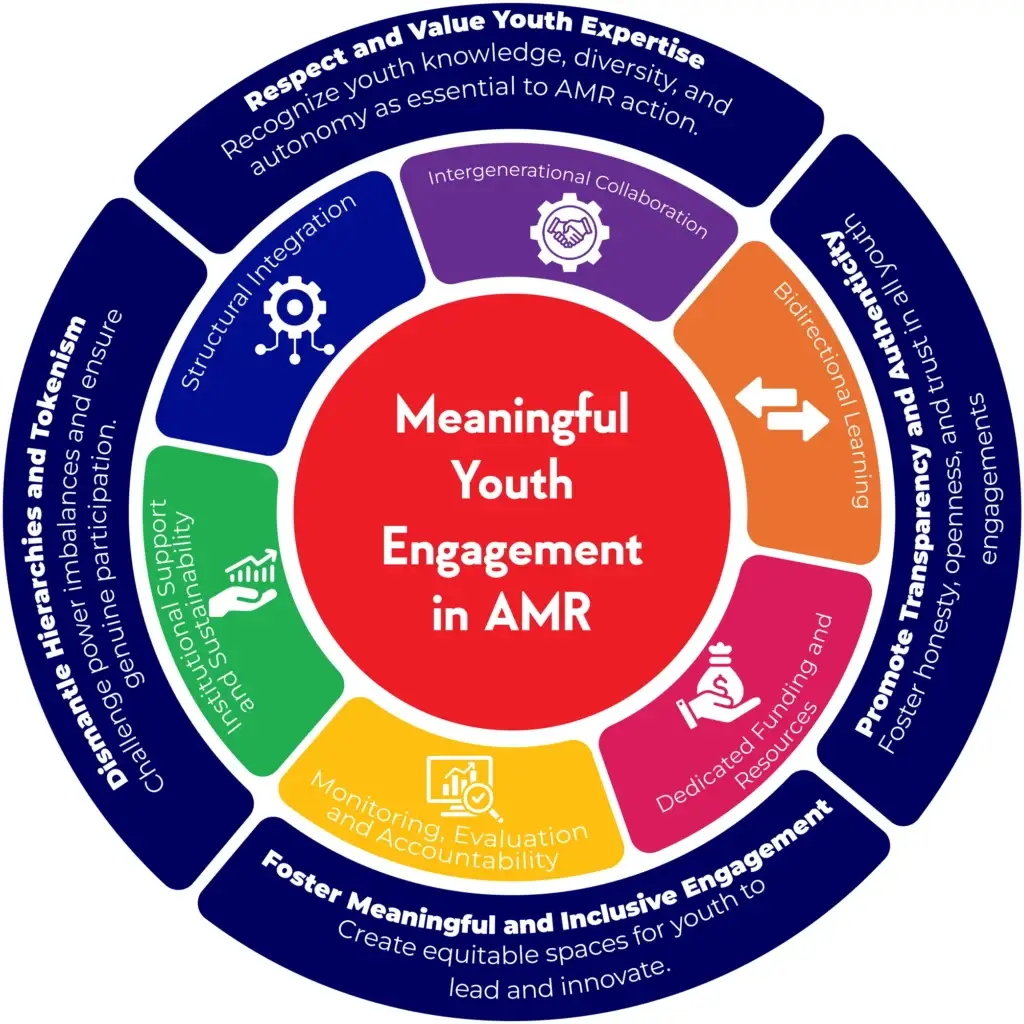
To make this practical, we put forth the Meaningful Youth Engagement in AMR Wheel (see attached image). At its core are six strategies: structural integration, intergenerational collaboration, bidirectional learning, dedicated funding and resources, monitoring, evaluation and accountability, and institutional support and sustainability. Around them sit four guiding principles: respect and value youth expertise, promote transparency and authenticity, foster meaningful and inclusive engagement, and dismantle hierarchies and tokenism.
MYE means structural integration. Young people should hold formal seats on technical teams and advisory boards, with defined roles, terms of reference and annual review. We went as far as calling for legally binding mandates for youth inclusion in AMR policymaking. That commitment needs money behind it, youth microgrant schemes co-designed with young people, a youth budget line in annual strategic plans, and simpler application processes that accept videos or infographics.
Meaningful engagement positions youth as accountability actors too, youth representation in AMR oversight committees, independent youth accountability networks, and youth-driven scorecards and shadow reports that track government pledges. Contributions should be formally recognised through remuneration or compensation for time, authorship, certification and references, agreed with young people beforehand. Partners should be transparent from the outset about how much influence youth will have, inform them before changes happen, and show how their input was used. And engagement must deliberately reach beyond the usual faces to include youth from underserved and marginalized communities.
Where it falls into tokenism, the most persistent gap is the awareness box, most organisations still see young people as best suited only for awareness work. Engagement is often ad-hoc and episodic, rarely written into monitoring and evaluation systems or strategic plans. Too often youth are invited for show, to tick a box, to fill a room and their input never reaches decisions.
Patronization makes this worse. Young people are often seen as less knowledgeable or too young to understand complex issues, undermining the value of their contributions. Their lived experiences are often given less importance than formal scientific knowledge, while some consultations guide them towards answers that organizers already expect.
Without meaningful roles in decision-making, capacity-building can leave young people frustrated and create the impression of engagement without giving them real influence. Having a platform to speak does not mean having the power to shape decisions. Furthermore, there is little data on how much AMR funding goes towards youth-led initiatives, making it difficult to understand the scale of the funding gap.
The 2024 Political Declaration and the updated Global Action Plan set targets to 2030 and beyond. What role should young people play in holding governments to account on these commitments?
It is important to acknowledge governments have already committed to involving youth. In paragraph 29 of the 2024 Political Declaration, Member States pledged to involve youth, alongside communities, civil society and other stakeholders, in the design, implementation and review of national action plans on AMR. The question now is whether that review role is real.
In our 2025 paper in PLOS Global Public Health, we argued that independent youth accountability networks should track government and institutional AMR commitments, using public tools such as youth-driven scorecards and shadow reports. But accountability from the outside only goes so far. Young people need a defined role inside the monitoring and evaluation of national action plans, helping set indicators, taking part in routine reviews, and having our findings formally acknowledged in progress reports. Without that, youth monitoring stays a parallel exercise that governments can ignore.
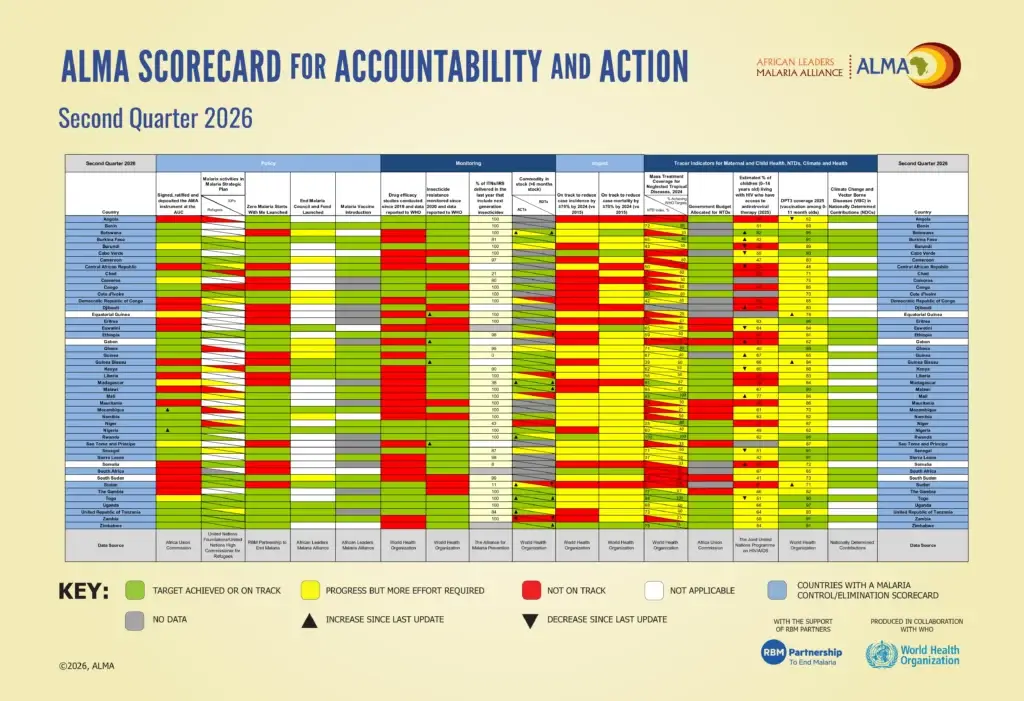
Africa already has a working model. The African Leaders Malaria Alliance publishes a quarterly scorecard (ALMA Scorecard, Q2 2026), produced with WHO, that rates every country red, amber or green on malaria targets, commodity stocks, policy and financing, and heads of state review it. Colour-coded, comparable and regular public data moves governments. AMR has nothing equivalent, and young people are well placed to help build it.
You have worked with young public health professionals across regions. What are they seeing on the ground that policy makers are missing on AMR?
What policy makers are missing is not only the problems young professionals see, but the solutions they are already building. The gap is not youth capacity. It is the bridge between what young people are doing on the ground and the rooms where decisions are made. Young people bring lived experience that no policy document captures, for instance as patients, as carers buying medicines for family members, as students and as early career health workers at the point of prescribing. That experiential knowledge deserves the same weight as technical expertise when national plans are designed.
The first thing young professionals see is a language barrier. AMR is still discussed mostly in English and in technical terms that mean little to a mother buying antibiotics at a drug shop or a farmer treating sick poultry. The draft updated Global Action Plan rightly calls for messaging developed with target groups and translated locally. Young people, who often move easily between technical spaces and their communities, are well placed to do that translation into local languages and everyday terms.
Second, awareness is not enough. Every November we run campaigns, yet behaviour on the ground changes slowly. For policymakers, these campaigns risk becoming a box-ticking exercise, where awareness activities are organised and reported as achievements. Young professionals want to move from raising awareness to driving positive behaviour change, and peer influence is one of the most underused tools for doing it. Young people are social agents of change that can influence the choices of their friends, siblings, parents and communities in ways official or political campaigns rarely can.
Third, the environment is visible on the ground but missing in policy. Young people working in informal settlements see untreated wastewater, poor sanitation and unsafe disposal of medicines every day, yet these drivers remain thin in most national action plans. The UNEA 7/11 resolution on the environmental dimensions of AMR is a welcome step, and the task now is to carry it into national plans and budgets.
Fourth, there is a gap in education. Many students reach university, and even graduate as health professionals, with little grounding in AMR or One Health. Governments committed in the 2024 Political Declaration to integrate AMR into primary, secondary and tertiary curricula. AMR remains poorly integrated into education, leaving future health professionals without the knowledge needed to address it.
Finally, young people are not waiting. They are creating the structures that keep driving action on AMR, university clubs, mentorship programmes, and youth-led organizations that connect cities and countries. Policy makers can strengthen these by bringing them into national AMR planning, funding them, and listening to what they report back.
This year’s theme is “One Health, one action: Prevent AMR now”. If you could ask every sector to take two actions now, what would they be?
To state it briefly, my first ask would be prevention, stopping the infection before anyone needs the antimicrobials and to effectively do this we must think in a One Health approach to make this possible. My second ask would be meaningful engagement of youth in AMR interventions, we must work to ensure youth are the centre of the agenda rather than the periphery.
Hafeez Hamza
Board Member and Co-Lead AMR Committee, Young WFPHA