Category: Governance

  • Signature of MoU to Advance Regional and Health Diplomacy

    Signature of MoU to Advance Regional and Health Diplomacy

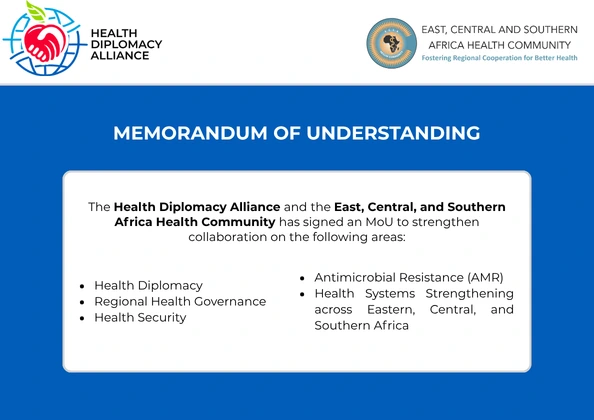
    We are pleased to announce the signing of a Memorandum of Understanding (MoU) with the East, Central, and Southern Africa Health Community (ECSA-HC), marking an important step toward strengthening collaboration in health diplomacy, regional health governance, and capacity development across Africa and beyond.

    The MoU establishes a framework for cooperation between the two organizations in areas of shared interest, recognizing the growing importance of diplomacy, partnership building, and cross-sector collaboration in addressing today’s complex health challenges.

    Through this collaboration, HDA and ECSA-HC aim to promote dialogue and knowledge exchange on health diplomacy and global health while supporting initiatives that strengthen leadership, institutional capacity, and regional cooperation.

    The partnership will also create opportunities for joint activities, including policy engagement, research, training, technical exchanges, and the convening of stakeholders from across government, academia, civil society, and international organizations.

    The agreement also underscores the importance of regional organizations in shaping global health discussions and ensuring that diverse perspectives contribute to international decision-making processes. By combining HDA’s expertise in health diplomacy with ECSA-HC’s extensive regional network and experience, both organizations are well positioned to advance practical solutions that respond to evolving health priorities.

  • 78th World Health Assembly

    78th World Health Assembly

    Amidst severe financial limitations, the 78th World Health Assembly (WHA78) took place in Geneva, Switzerland, from May 19–27, 2025. Following the formal resignation of Argentina and the United States, as well as donor fatigue, the WHO’s 2026–2027 budget was cut from US$5.3 billion to US$4.2 billion. To stabilize WHO’s core funding, Member States responded by approving a 20% increase in assessed contributions for the second consecutive biennium. Even so, the organization will need to implement additional cutbacks, such as possible layoffs, divisional reorganizations, and decentralization to regional offices., which is expected to take place next month.

    The WHO Investment Round attracted pledges totaling more than US$210 million. In addition to China, Norway, France, Germany, and other countries, Switzerland contributed 66 million CHF, or around US$80 million. This support was reinforced by philanthropic foundations, indicating a shared awareness of WHO’s vital role in addressing global health issues.

    During consultations, the proposed Global Plan of Action on Climate Change and Health encountered opposition. The WHO’s involvement in adaptation and mitigation initiatives, as well as the funding of adaptation in low-income nations, were the main points of contention. In the end, the idea was approved in principle, but it won’t be put into action unless WHO raises US$1.66 million to address the existing gap and another US$30 million until 2028.

    A resolution on skin diseases was adopted without contest, marking the first time these conditions have been recognized as a global public health priority. The resolution directs WHO to create a comprehensive framework addressing treatment, prevention, and equitable access, particularly for vulnerable populations, with a budget of $510,000 for 2026-2027.

    The Assembly reaffirmed the Global Action Plan on Antimicrobial Resistance (AMR), which is set for a complete update in 2026. Countries voiced support for the One Health framework, and WHO was entrusted with creating new implementation tools. The implementation of stronger criteria for antimicrobial manufacturing waste showed a commitment to connecting industrial practices with environmental and human health effects.

    In addition, the Assembly approved Indonesia’s request to move from the South-East Asia Region to the Western Pacific Region, demonstrating WHO’s ability to adjust to geopolitical changes.

    The Executive Board concluded its 157th session on 28–29 May 2025, approving new procedures for ethical oversight of WHO’s leadership. Following extensive consultations, the Board approved a structured framework for examining charges of misconduct against the Director-General, which included the formation of an independent review panel.

    1 – Read more about the Programme, Budget and Administration Committee (PBAC) 42nd meeting, held 14–16 May 2025.

    2 – Read more about the 78th World Health Assembly (19–27 May 2025).

    3 – Read more about the 157th Executive Board meeting (28–29 May 2025).

  • Health Diplomacy Alliance Joins Global Public Investment (GPI) Initiative

    Health Diplomacy Alliance Joins Global Public Investment (GPI) Initiative

    GPI advocates for the pivotal role of international public finance in addressing urgent global challenges such as the climate emergency, pandemic preparedness, and achieving the Sustainable Development Goals (SDGs). It promotes a structured approach to meeting global ambitions through sustained investments in essential goods, capital, and infrastructure.

    GPI is guided by three core principles:

    Inclusive Participation: Emphasizing a horizontal approach where all countries collaborate equally, moving away from traditional top-down decision-making and paternalistic donor-recipient dynamics.

    Shared Decision-Making: Promoting a more representative governance structure that includes civil society, enhancing transparency and effectiveness in international public finance.

    Universal Benefits: Prioritizing equitable outcomes by directing investments towards addressing poverty, inequality, and sustainability needs globally, fostering resilience across all communities.

    At the Health Diplomacy Alliance, we are dedicated to enhancing resilient health systems through sustainable funding mechanisms at both global and national levels. Collaborating with GPI, our goal is to promote effective health diplomacy actions that advocate for policies and initiatives prioritizing stability, predictability, resilience, and long-term investment in health. 

    For more information on HDA’s collaboration with GPI and our efforts in health diplomacy, please visit hdalliance.org