Tag: regional

  • Launch of the Joint Task Force on the ICJ Advisory Opinion

    Launch of the Joint Task Force on the ICJ Advisory Opinion

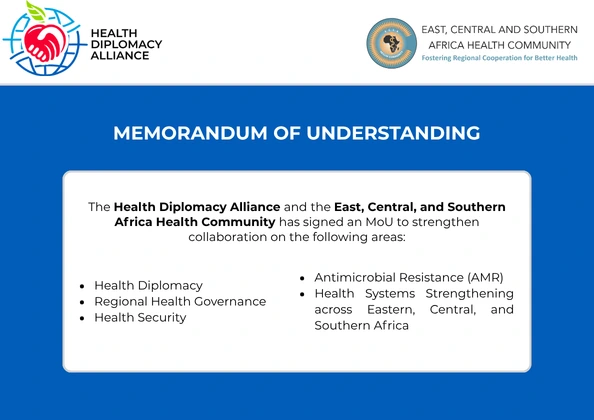
    We are pleased to announce the signing of a Memorandum of Understanding (MoU) with the East, Central, and Southern Africa Health Community (ECSA-HC), marking an important step toward strengthening collaboration in health diplomacy, regional health governance, and capacity development across Africa and beyond.

    The MoU establishes a framework for cooperation between the two organizations in areas of shared interest, recognizing the growing importance of diplomacy, partnership building, and cross-sector collaboration in addressing today’s complex health challenges.

    Through this collaboration, HDA and ECSA-HC aim to promote dialogue and knowledge exchange on health diplomacy and global health while supporting initiatives that strengthen leadership, institutional capacity, and regional cooperation.

    The partnership will also create opportunities for joint activities, including policy engagement, research, training, technical exchanges, and the convening of stakeholders from across government, academia, civil society, and international organizations.

    The agreement also underscores the importance of regional organizations in shaping global health discussions and ensuring that diverse perspectives contribute to international decision-making processes. By combining HDA’s expertise in health diplomacy with ECSA-HC’s extensive regional network and experience, both organizations are well positioned to advance practical solutions that respond to evolving health priorities.

  • Signature of MoU to Advance Regional and Health Diplomacy

    Signature of MoU to Advance Regional and Health Diplomacy

    We are pleased to announce the signing of a Memorandum of Understanding (MoU) with the East, Central, and Southern Africa Health Community (ECSA-HC), marking an important step toward strengthening collaboration in health diplomacy, regional health governance, and capacity development across Africa and beyond.

    The MoU establishes a framework for cooperation between the two organizations in areas of shared interest, recognizing the growing importance of diplomacy, partnership building, and cross-sector collaboration in addressing today’s complex health challenges.

    Through this collaboration, HDA and ECSA-HC aim to promote dialogue and knowledge exchange on health diplomacy and global health while supporting initiatives that strengthen leadership, institutional capacity, and regional cooperation.

    The partnership will also create opportunities for joint activities, including policy engagement, research, training, technical exchanges, and the convening of stakeholders from across government, academia, civil society, and international organizations.

    The agreement also underscores the importance of regional organizations in shaping global health discussions and ensuring that diverse perspectives contribute to international decision-making processes. By combining HDA’s expertise in health diplomacy with ECSA-HC’s extensive regional network and experience, both organizations are well positioned to advance practical solutions that respond to evolving health priorities.

  • Regional Cooperation Towards a Healthier Future: The Role of Health Diplomacy

    Regional Cooperation Towards a Healthier Future: The Role of Health Diplomacy

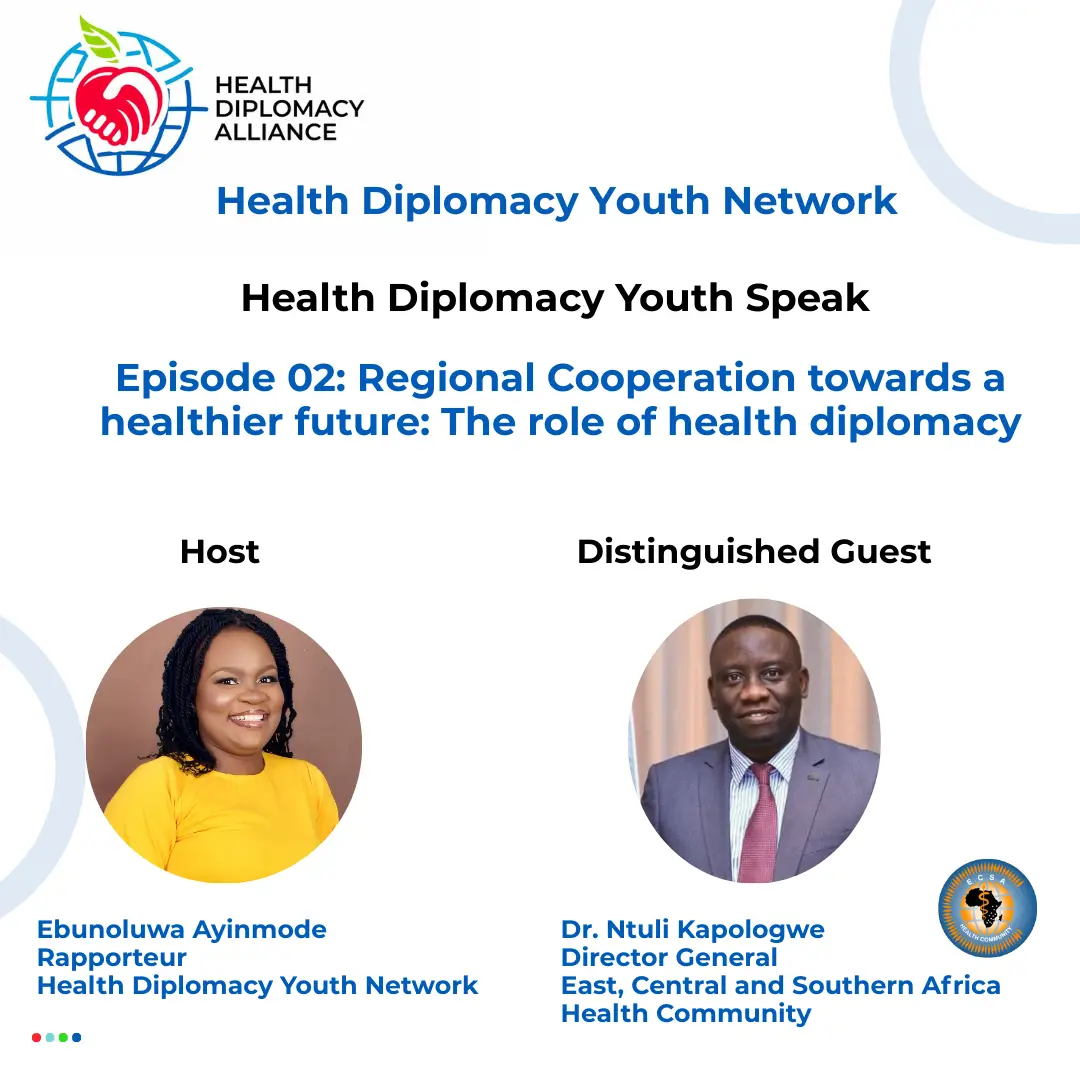
    How can regional cooperation strengthen health systems and improve health outcomes? In this episode of Health Diplomacy Youth Speaks, HDYN Rapporteur Ebunoluwa Ayinmode speaks with Dr. Ntuli Kapologwe, Director General of the East, Central and Southern Africa Health Community (ECSA-HC), about the power of regional health diplomacy. Their conversation explores cross border collaboration, health workforce development, resilient health systems, and coordinated responses to shared challenges. Drawing on ECSA-HC’s experience, this episode offers valuable insights into how partnerships and sustained dialogue can advance a healthier and more equitable future.

  • Africa’s Health Financing in a New Era

    Africa’s Health Financing in a New Era

    Africa’s health sector faces a major financing crisis, with a 70% drop in ODA from 2021 to 2025 threatening critical health programs and SDG 3. Africa CDC’s new strategy focuses on domestic resource mobilization, innovative and blended financing, with governance as a key enabler.

    A two-phase plan (2025–2030) and a Health Financing Scorecard will guide and track progress.

    Read more: Addressing-Health-Financing-Challenges-in-Africa-Through-Domestic-Resource-Mobilization-and-Innovative-Financing-Mechanisms_7-April-2025 

  • Investing in Health Financing: Building Resilient and Sustainable Healthcare Systems

    Investing in Health Financing: Building Resilient and Sustainable Healthcare Systems

    78th World Health Assembly

    Investing in Health Financing: Building a Resilient and Sustainable Healthcare System

    On May 20, 2025

    8 AM-10 AM

    The event focused on addressing the urgent need for sustainable health financing in a rapidly changing global landscape, where health systems are facing increasing pressures. Katherine Urbáez, Executive Director of the Health Diplomacy Alliance and moderator, opened the discussion by underscoring the importance of sustainable health financing, noting that over the past decade, Official Development Assistance has decreased while growing expenditures on security have further strained health budgets.

    She also emphasised the need for health diplomacy to balance global solidarity with national ownership to ensure support for global health institutions like the WHO remains predictable and robust.

    The first keynote speaker, Dr. Jean Kaseya, Director General of Africa CDC, made a strong call for a paradigm shift in health financing: “The plan is not to fill gaps, it’s to rethink the system of health financing.” He emphasised the need for stronger governance, data-driven systems, and sovereign control over health strategies and budgets.

    Dr. Kaseya also called for the utilisation of domestic resources and innovative financing mechanisms like health taxes to address the decline in ODA and the rising demand for countries to “do more with less.”
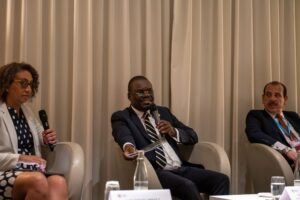
    Hon. Dr. Amr Kandeel, Assistant Minister of Health for Preventive Medicine in Egypt and second keynote speaker, addressed the impact of global inflation and supply chain disruptions on health systems. He shared Egypt’s commitment to Universal Health Coverage (UHC) through its Universal Health Insurance system, which has already quadrupled the health budget in its second phase. Dr. Kandeel stressed the importance of investing in digital infrastructure, workforce development, and prevention, while promoting inclusive governance and public-private partnerships to build an equitable and sustainable health system.

    On the financing innovation front, Dr. Mary-Ann Etiebet, CEO of Vital Strategies, outlined the “triple shocks” that are battering health systems worldwide: stagnation in development aid, tightening government budgets, and growing pressures from non-communicable diseases (NCDs), climate change, and demographic shifts. She highlighted the potential of health taxes, particularly on sugar, tobacco, and alcohol, as effective tools to sustain health system funding. She called for better governance, smarter data infrastructure, and stronger management to ensure governments can prioritise spending effectively.

    CEO of Grand Challenges Canada, Dr. Karlee Silver, brought a grassroots innovation perspective to the discussion. She illustrated how catalytic capital, including blended grants, loans, and equity, can help overcome market failures and scale promising health innovations. She discussed the need to rethink the health system and leverage innovative approaches, such as development impact funds and results-based financing, to accelerate positive change.

    Leslie Rae Ferat, President of the NCD Alliance and Executive Director of the Global Alliance for Tobacco Control, warned that NCDs, which are responsible for 80% of preventable deaths, exacerbate vulnerability to health crises like COVID-19. She underscored that by addressing NCDs through health taxation, countries can improve public health outcomes and achieve long-term savings for their health systems.

    Dr. Ballkis Abdelmoulla, a member of the WHO Youth Council, called for a coordinated approach to donor funding and greater support for national programs aimed at preventing NCDs, such as cervical cancer screening and HPV vaccination.


    The discussions made it clear that building resilient and sustainable health systems requires a combination of national ownership, innovative financing mechanisms, strong governance, and coordinated multilateral efforts to ensure health systems are better equipped to meet both current and future challenges.


    Key takeaways:

    • Need to rethink the entire health financing system with innovative financing mechanisms and solutions.
    • Scaling grassroots innovations and innovative financing, such as health taxes, generates revenue and reduces harmful consumption.
    • Investment is needed in digital infrastructure, workforce, prevention, and private-public partnerships.
    • Sustainable health systems depend on multilateral cooperation, innovation, and national leadership.