




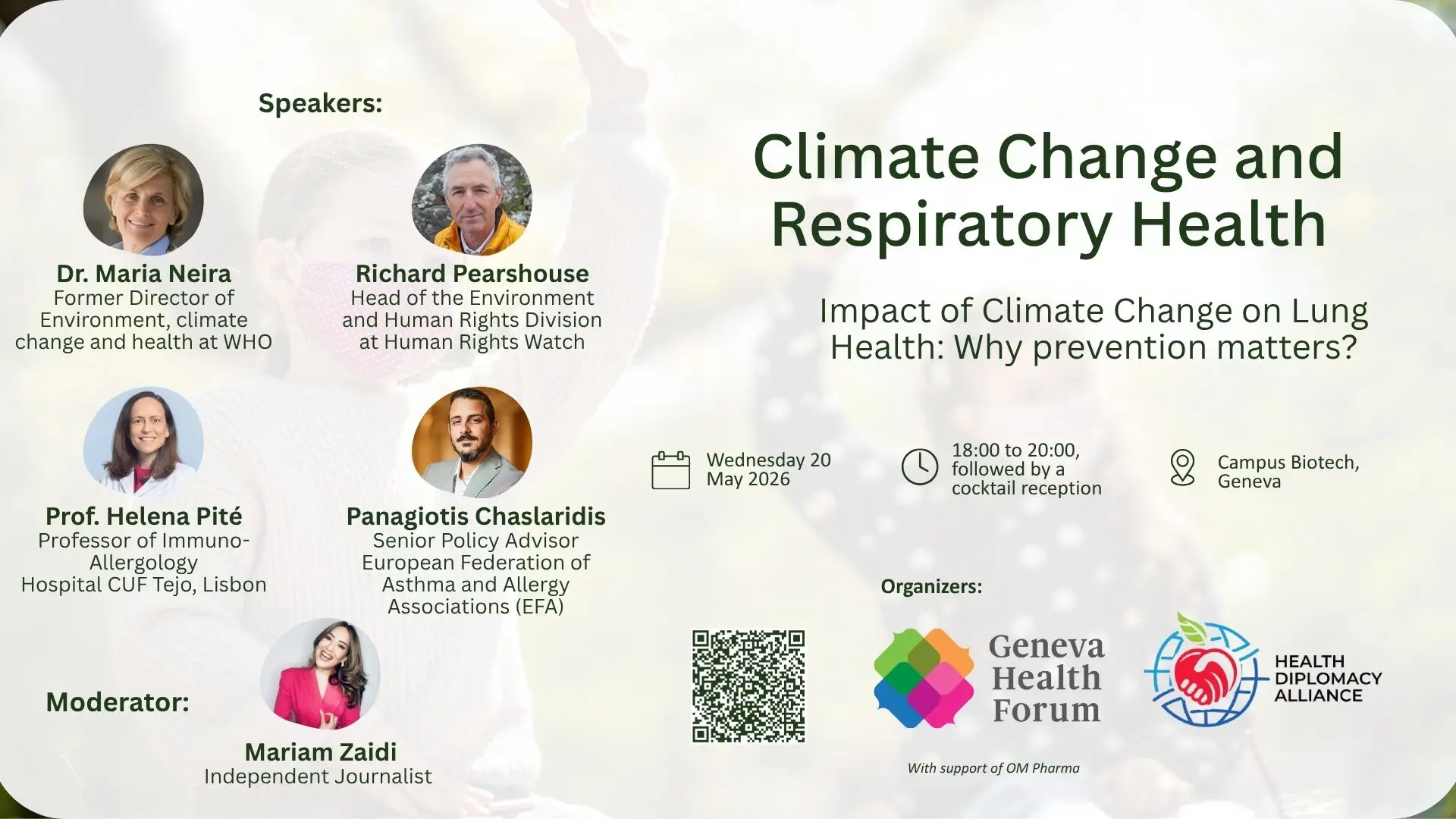
This side event, organized by Health Diplomacy Alliance and Geneva Health Forum, and explores the growing impact of climate change on respiratory health and the increasing burden of respiratory infections worldwide.
Rising temperatures, air pollution, and changing environmental conditions are contributing to worsening air quality, prolonged allergy seasons, and heightened vulnerability to diseases such as asthma and chronic obstructive pulmonary disease (COPD).
Bringing together experts, policymakers, and practitioners, the session will examine how climate-related factors influence respiratory health; particularly among vulnerable populations; and discuss practical prevention strategies.
The event will also focus on bridging research and policy to strengthen public health responses, promote innovation, and enhance resilience in the face of climate-driven health challenges.
Former Director of Environment, climate change and health at WHO
Journalist, Independant
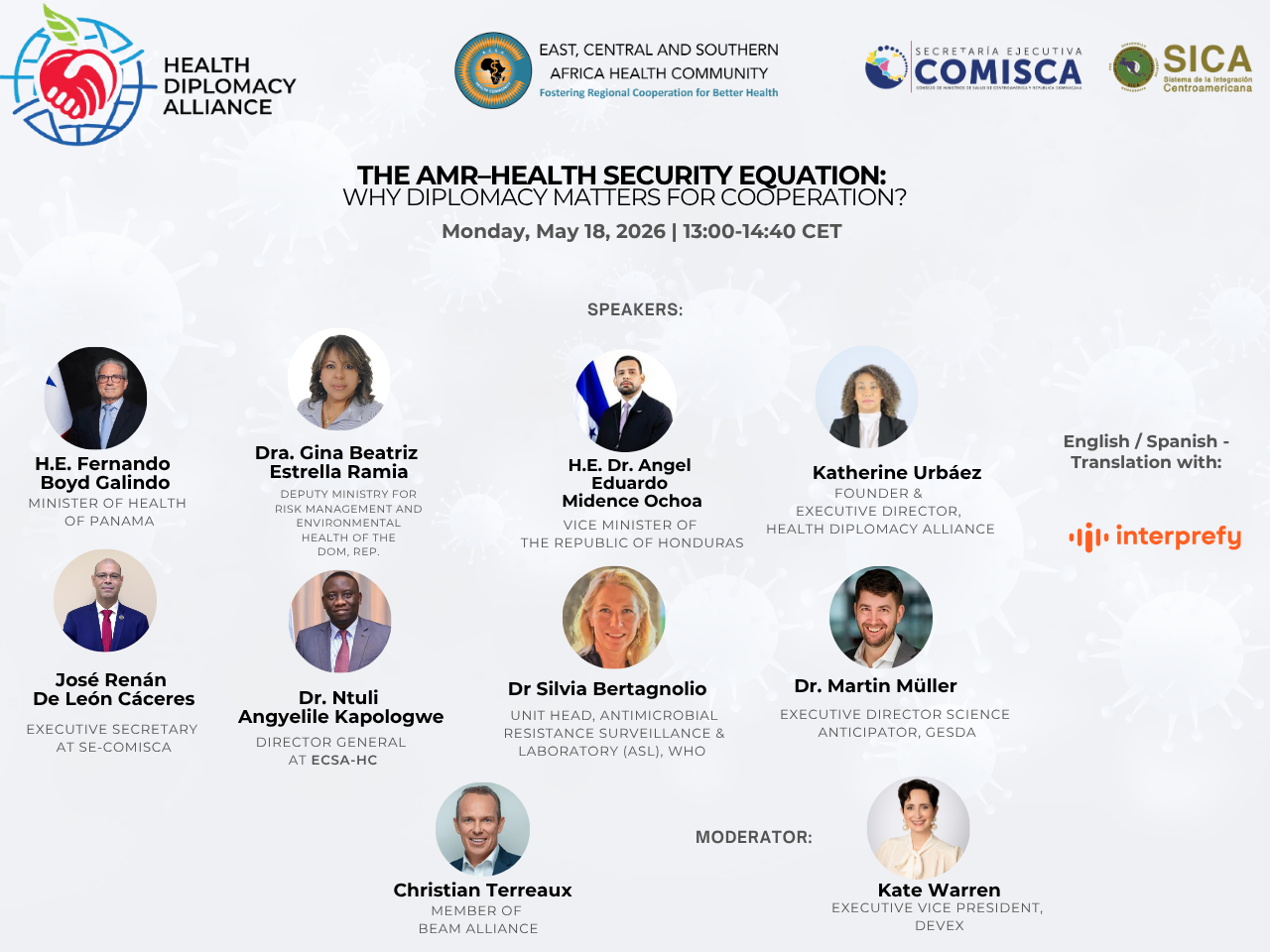
Antimicrobial resistance (AMR) represents one of the most urgent and complex health challenges of our time. As life-saving drugs lose effectiveness, previously treatable infections risk becoming untreatable, crossing state borders, and threatening global health security. AMR can reverse the gains of modern medicine, including surgeries, cancer therapies, and intensive care. Without decisive action, AMR could result in millions of deaths annually and impose severe economic losses that strain health systems and national economies.
Excessive antibiotic use in agriculture also raises resistance to zoonotic diseases, indirectly impacting human health. These connections make AMR a cross-cutting issue hindering progress towards the Sustainable Development Goals (SDGs). Because resistant pathogens move between humans, animals, and ecosystems, and with globalized trade in livestock and agriculture, AMR’s inherently transboundary nature necessitates a One Health approach-driven international cooperation.
This event will explore why addressing AMR demands robust health diplomacy and a globally coordinated response grounded in the One Health approach. Strengthening hygiene and infection prevention, ensuring responsible antimicrobial use, improving surveillance systems, integrating into health emergency preparedness response and resilience, and accelerating investment in new diagnostics, treatments, and vaccines are essential pillars of an effective strategy. Bringing together diverse stakeholders, including policymakers, scientists, health practitioners, international organization and civil society this discussion aims to chart actionable pathways that mitigate AMR as a global health and security objective.
As part of the 79th World Health Assembly, the Health Diplomacy Alliance convened a side event on 18 May 2026 to discuss antimicrobial resistance (AMR) as a health security issue. The event examined how AMR moves across human health, animal health, agriculture, water systems, environment, trade and financing. The discussion was moderated by Kate Warren, Executive Vice President at Devex. Katherine Urbaez, Founder and Executive Director of the Health Diplomacy Alliance, moderated the Spanish-language regional segment.
The purpose of the discussion was to discuss the implementation. Existing commitments, national action plans and regional strategies do not by themselves create laboratory capacity, surveillance systems, financing, regulation or public awareness. The discussion therefore focused on how commitments can be moved into practical action.
Kate Warren opened the session by placing AMR within the wider health security agenda. She explained that the event was taking place on the opening day of the 79th World Health Assembly, where health leaders were discussing decisions with long-term effects on global health. She described AMR as a threat to the basic functions of modern medicine, including routine infection treatment, surgery, cancer care and intensive care.
Kate Warren argued that AMR should be understood as part of health security planning. Resistant infections reduce the effectiveness of life-saving drugs and make treatable infections harder to manage. This affects individual patients, but it also affects the capacity of health systems to function during routine care and emergencies. She also linked AMR to economic losses and development setbacks, noting that the consequences would be felt by health systems and national economies.
AMR is already recognized in political declarations, G20 targets and ministerial commitments. The more difficult question is how those commitments are reflected in preparedness budgets, health security planning and implementation systems. The problem is therefore the gap between evidence, political commitment and operational capacity.
Dr. Silvia Bertagnolio, Unit Head for Antimicrobial Resistance Surveillance and Laboratory at WHO, addressed this problem through diagnostics and surveillance. She stressed that countries need stronger laboratory systems and better access to diagnostics in order to know where resistance is occurring and how it is changing. She also described access to diagnostics as a human rights issue. This matters because without diagnosis, patients may receive inappropriate treatment and governments may lack the data needed to respond.
H.E. Fernando Boyd Galindo, Minister of Health of Panama, connected AMR to Panama’s geographic position. He described Panama as a strategically connected country. This connectivity is an advantage, but it also creates health responsibilities. He then referred to migration through Panama and explained that the movement of people also involves the possible movement of pathogens. His main point was that AMR cannot be addressed by one country alone.
Minister Galindo also stressed that AMR does not know borders. Panama’s role as a transit country means that national health risks also have regional implications. Migration, trade, mobility and environmental exposure all create routes through which resistant organisms can move. For this reason, national action plans need to be linked to regional surveillance and cooperation.
Sr. Jose Renan De Leon Caceres, Executive Secretary at SE-COMISCA, made a similar argument from the Central American perspective. He explained that Central American countries share borders, food systems and markets. He referred to the movement of agricultural and livestock products between countries, showing that practices in one country can affect others.
One Health was the main framework used by the speakers. Nevertheless, it was discussed as a governance issue rather than only as a technical concept. H.E. Dr. Angel Eduardo Midence Ochoa, Vice Minister of the Republic of Honduras, explained that the health sector has to convene other sectors, including environmental health, animal health, natural resources and related institutions. His point was that AMR cannot be managed by the Ministry of Health alone.
Vice Minister Midence described the work of building coordination between sectors for mitigation, detection and disease management. He also connected AMR to access to medicines, prescription practices and regulatory control. AMR governance depends on routine public administration. Planning, prescription control, access to medicines and regulatory capacity are the mechanisms through which AMR policy becomes operational.
H.E. Dra. Gina Beatriz Estrella Ramia, Deputy Minister for Risk Management and Environmental Health of the Dominican Republic, also described AMR as a One Health problem. She argued that AMR is no longer only an issue inside hospitals. It is now linked to borders, agriculture, aquaculture, water, sanitation and environmental systems. Speaking from the perspective of an island country, she referred to agriculture and aquaculture, including fish, mollusks and crustaceans, as sectors that need to be included in AMR surveillance and control.
Dra. Estrella Ramia also raised the question of governance and budgets. She explained that no sector should be treated as more important than the others. Each sector has a responsibility. This reflects a central difficulty in One Health implementation. The approach requires different ministries and agencies to work together even when they have different mandates, budgets and incentives.
Sr. Jose Renan De Leon Caceres referred to the regional One Health strategy in Central America. He explained that the strategy was approved through the health, agriculture and environment ministers. This gave the issue political weight, not only technical support.
The environmental dimension was discussed most clearly by Minister Fernando Boyd Galindo and Dra. Gina Beatriz Estrella Ramia. Minister Galindo referred to water systems, river basins and ecological balance in Panama. He argued that years of insufficient attention to water and environmental systems can create wider health consequences. AMR cannot be separated from sanitation, wastewater and environmental management.
Dra. Estrella Ramia also placed water and sanitation within AMR surveillance. She explained that environmental health, water, agriculture, livestock and aquaculture are all part of the resistance problem. Because resistant organisms and antimicrobial residues can circulate through water systems and environmental pathways. If these systems are not monitored, AMR surveillance remains incomplete.
This part of the discussion showed that environmental surveillance remains a weak part of AMR implementation. Countries may focus first on hospitals and clinical laboratories, but AMR is also shaped by water treatment, sanitation infrastructure, agricultural runoff and waste management. These areas often require investment outside the health sector, which is why political coordination and financing are necessary.
A repeated theme was that AMR commitments need financing. Minister Fernando Boyd Galindo argued that health should not be treated only as a cost. It should be treated as an investment in a healthy population. He linked weak investment in water, sanitation and health systems to later public health and economic consequences. Underinvestment does not remove costs. It only moves them into the future.
Dr. Ntuli Angyelile Kapologwe, Director General of ECSA-HC, connected this point to ministries of finance. He argued that ministries of finance need to be part of AMR discussions from the beginning. Because AMR strategies cannot be implemented if they remain only in technical health documents. Financing decisions determine whether laboratories, surveillance systems, stewardship programmes and public campaigns can continue.
Standalone initiatives may raise attention, but they can be difficult to sustain. AMR work needs to be connected to national budgets, health security planning, laboratory systems, primary care, environmental monitoring and regional platforms. Otherwise implementation depends on short-term projects and external support.
Katherine Urbaez also directed attention to what needs to be monitored in implementation. The relevant questions are what has been committed, who is responsible, what is financed, what is monitored and what still needs political attention. These questions are important because they move the discussion from general political support to accountability.
Dr. Silvia Bertagnolio’s intervention focused on surveillance and diagnostics. She explained that representative data is needed to understand the burden and spread of AMR. Weak laboratory capacity creates weak data, and weak data makes policy less precise. This is especially important in lower-resource settings where access to diagnostics is limited and infections may be treated without laboratory confirmation.
Sr. Jose Renan De Leon Caceres also discussed regional technical capacity. He referred to work on laboratory strengthening and early diagnosis. He also mentioned support from the Pandemic Fund to strengthen laboratories and surveillance systems and stated that AMR surveillance requires systems that can share information, connect platforms and report data in a way that can be used for decision-making.
The discussion therefore treated data as a governance tool. Diagnostics and laboratories help patients receive better care, but they also make AMR visible to governments. Without data, it is difficult to know whether commitments are producing results. Surveillance is therefore both a health function and an accountability function.
Vice Minister Angel Eduardo Midence Ochoa linked AMR to prescription practices, access to medicines and public policy. He stated that regulation is a gradual process of building state capacity. Countries need systems that can control inappropriate use of antibiotics while still protecting access to essential medicines. This is exclusively difficult when health, agriculture and trade interests overlap.
The discussion also referred to the relationship between AMR regulation and economic activity. In Honduras, the issue was connected to agricultural production and export credibility. Strong traceability systems can help a country show where contamination occurred and protect both public health and legitimate trade. Regulation is can protect economic interests when it is based on evidence and clear systems.
Dra. Gina Beatriz Estrella Ramia raised the issue of public behaviour. She referred to the common practice of people buying antibiotics for flu-like illness because they believe antibiotics will help them recover. AMR is not only produced by weak legislation or weak laboratories. It is also produced by everyday behaviour, misinformation and easy access to antibiotics without proper guidance.
For this reason, education was discussed as part of AMR implementation. Public campaigns, schools, universities and community platforms can help explain when antibiotics are needed and when they are not. Regulation is necessary, but it may not be sufficient if public expectations and prescribing behaviour do not change.
Martin Mueller, Executive Director Science Anticipator at GESDA, addressed the role of new technologies, including artificial intelligence, decentralised surveillance and improved diagnostics. These tools can support earlier detection and better prediction. However, they also require governance systems that can keep up with scientific change.
Christian Terreaux, Member of BEAM Alliance, brought attention to the role of innovation in the AMR response. Innovation is relevant because AMR requires better diagnostics, treatments and tools. However, innovation alone is not enough. New tools need financing, access pathways and regulatory systems if they are to be used in countries with different levels of capacity.
The point from this part of the discussion was that science can move faster than governance. This creates risks. If advanced diagnostics and prediction systems are available only to some countries, technology may widen existing inequalities. For this reason, innovation needs to be linked to access, financing and implementation.
Health diplomacy was treated as a practical requirement for AMR implementation. Kate Warren framed the event around what health diplomacy has to do with moving commitments into action. Dr. Ntuli Kapologwe stated this directly by arguing that diplomacy has to be present in AMR work. The reason is that AMR requires cooperation across ministries, countries and sectors.
Katherine Urbaez’s questions linked national experiences to regional and multilateral cooperation. She asked how Panama understood concrete risks, how Central America viewed shared responsibility, and how the discussion related to multilateral and commercial issues. This showed health diplomacy as a way of connecting technical problems to political decision-making.
Regional institutions were also important in the discussion. SE-COMISCA was presented as a platform for Central American coordination across health, agriculture and environment. ECSA-HC was connected to regional health cooperation and financing discussions in East, Central and Southern Africa. WHO was linked to diagnostics, surveillance and technical guidance. These institutions matter because they help translate global commitments into regional and national systems.
The discussion therefore showed that diplomacy is needed at several levels. At the national level, it is needed to connect health, finance, environment, agriculture, trade and foreign affairs. At the regional level, it is needed for cross-border surveillance and shared food systems. At the global level, it is needed to maintain accountability and support equitable access to technologies and financing.
The event showed that AMR is already recognised as a major health and development challenge. The remaining difficulty is implementation. Speakers did not focus on proving the seriousness of AMR. They focused on the systems needed to respond to it.
Based on the discussion, the following conclusions can be drawn.
Minister of Health of Panama


Deputy Ministry for Risk Management and Environmental Health of the Dominican Republic
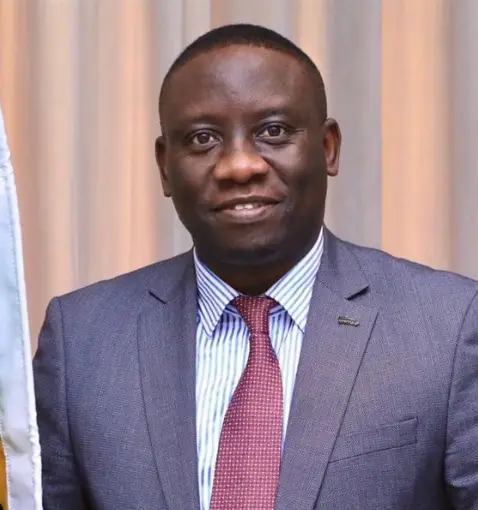
The East, Central, and Southern Africa Health Community (ECSA-HC), Director General

Vice Minister of the Republic of Honduras

UK Special Envoy on Antimicrobial Resistance (AMR)

Member of BEAM Alliance

Executive Director Science Anticipator, GESDA

Unit Head, Antimicrobial Resistance Surveillance & Laboratory (ASL), WHO
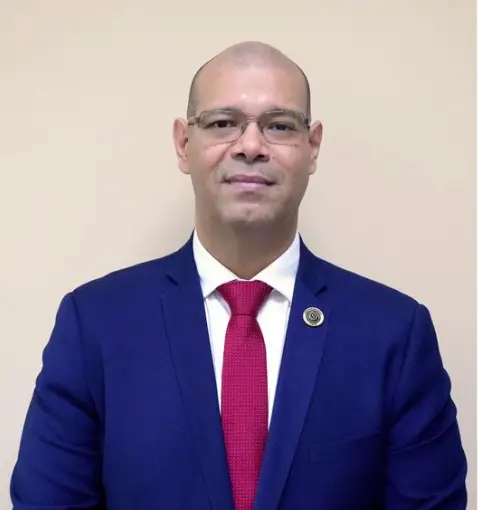
Executive Secretary at SE-COMISCA

Founder & Executive Director, Health Diplomacy Alliance

Executive Vice President, Devex