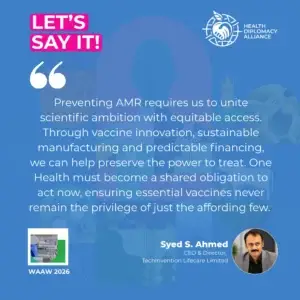

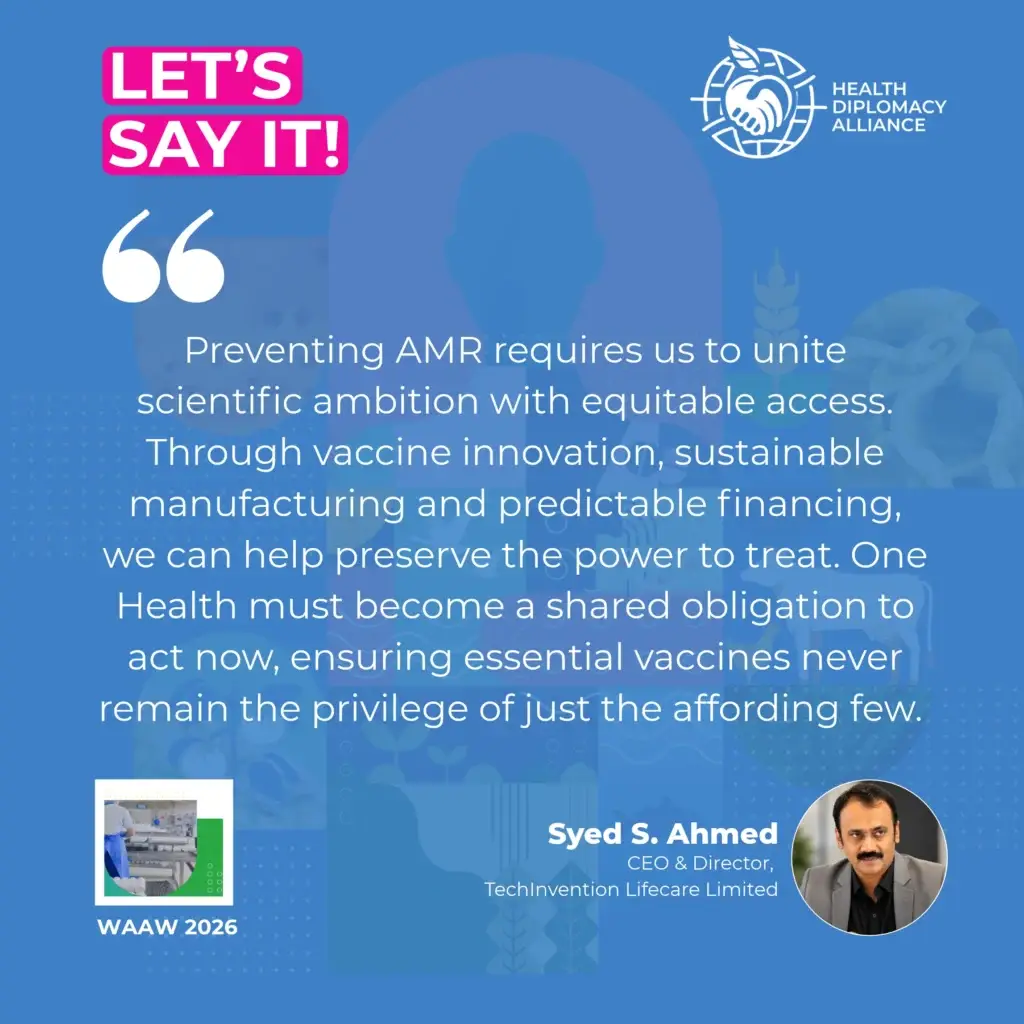
“Preventing AMR requires us to unite scientific ambition with equitable access. Through vaccine innovation, sustainable manufacturing and predictable financing, we can help preserve the power to treat. One Health must become a shared obligation to act now, ensuring essential vaccines never remain the privilege of just the affording few.”
By Syed S. Ahmed, CEO & Director, TechInvention Lifecare Limited
Several vaccines in TechInvention’s pipeline target pathogens where resistance is rising, such as pneumococcus, Shigella and Salmonella. How do you see vaccines contributing to preventing AMR, and why does this role still receive limited attention?
Vaccines offer an opportunity to prevent infections before resistance complicates their treatment. Effective new TB vaccines could reduce the burden of drug-susceptible and drug-resistant disease and the need for prolonged antibiotic treatment. Malaria vaccination can reduce illness and demand for antimalarial treatment; it can also reduce inappropriate antibiotic use for malaria-associated fever.
The eradication of smallpox and rinderpest demonstrates what sustained vaccination and coordinated disease control can achieve across human and animal health. That preventive ambition should inform our response to AMR.
At TechInvention, we are developing KochVac™ for tuberculosis and RossVac™ for malaria, alongside our Shigella and Pan-Salmonella vaccine programmes. These investigational candidates reflect our commitment to developing affordable vaccines for populations with substantial unmet needs. We approach affordability as a development requirement: process efficiency, reproducibility and the ability to scale must be considered early so that successful candidates have a credible pathway to accessible supply.
In my assessment, vaccines receive limited attention for three reasons. First, AMR is often framed primarily as a treatment and prescribing challenge, giving new antibiotics greater visibility than prevention. Second, immunisation and AMR priorities can sit within separate programmes and budgets. Third, vaccine value assessments may not fully account for antibiotic courses avoided, resistant infections prevented and the wider benefits to health systems. This can weaken the investment case for vaccination. Dedicated funding and explicit recognition of these benefits in AMR plans are therefore essential.

Many of the countries most affected by AMR depend on vaccines made elsewhere. What would it take to build vaccine manufacturing capacity in low- and middle-income countries, and what is the biggest obstacle today?
Building sustainable vaccine manufacturing capacity in low- and middle-income countries requires more than establishing manufacturing facilities. It calls for a comprehensive, end-to-end approach encompassing strategic planning, feasibility assessment, facility design and engineering, technology transfer, skilled workforce development, robust quality systems and regulatory strengthening.
At TechInvention, our consulting vertical plays a key role in enabling countries and organisations to establish and strengthen indigenous vaccine manufacturing capabilities. We support projects from the initial concept and feasibility assessment through Detailed Project Reports (DPRs), facility planning, process and technology selection, engineering design, equipment selection, infrastructure development and implementation planning. This includes evaluating local healthcare needs, manufacturing requirements, investment considerations and long-term operational sustainability to ensure that proposed facilities are technically feasible, economically viable and aligned with national priorities.
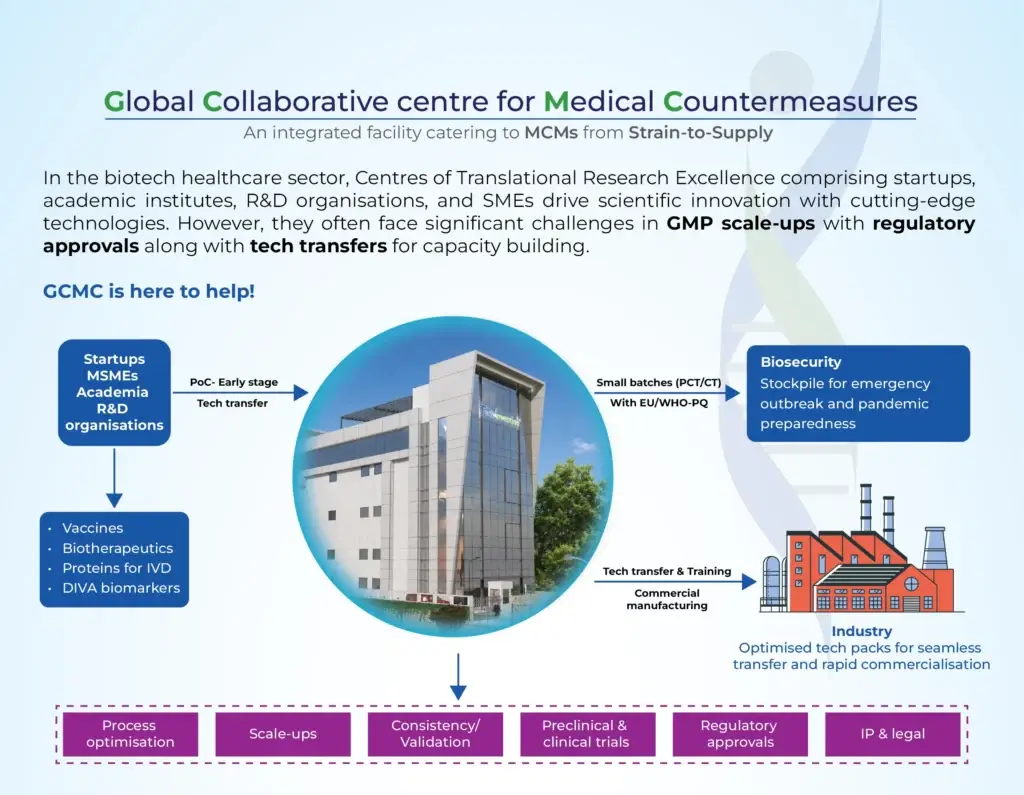
Beyond consulting, our integrated capabilities extend into vaccine R&D, process development, scale-up, technology transfer and GMP manufacturing through our Global Collaborative Centre for Medical Countermeasures (GCMC). This allows us to bridge the gap between infrastructure planning and actual manufacturing readiness, supporting countries and partners in translating their vaccine ambitions into operational capabilities.
Ultimately, developing sustainable local manufacturing ecosystems requires coordinated investments in infrastructure, technology, people and institutions. The biggest obstacle today, in my view, is not merely access to technology or infrastructure, but the lack of sustained financing and long-term commitment to make these investments viable. This is particularly challenging when procurement volumes and market demand remain uncertain. Long-term funding mechanisms, predictable procurement commitments and regional partnerships are therefore essential to building resilient and self-sufficient vaccine manufacturing ecosystems.
Vaccines that prevent resistant infections often lack a clear market. What incentives or financing would help companies like yours bring them to the people who need them most?
Our founding conviction is clear: “Access to Priority Vaccines Should Not Only be the Privilege of Just the Affording Few.” Our development of affordable vaccines must therefore be supported by financing that connects scientific progress with a dependable route to access.
I would prioritise milestone-based grants for clinical development, concessional capital for scale-up and technology transfer, and advance market commitments linked to affordable supply. Multiyear procurement agreements would help manufacturers plan capacity and sustain competitive pricing.
This year’s theme is “One Health, one action”. If you could ask every sector to take one action now, what would it be?
National and global AMR action plans should explicitly prioritise vaccine development and deployment, with dedicated funding for vaccines targeting AMR-relevant pathogens, manufacturing and immunisation programmes. Their value should include the antibiotic use and resistant infections they could help avert.
Such support must carry reciprocal commitments on quality, affordability and reliable supply, alongside funding for introduction and delivery. This would help companies pursue programmes whose public-health value exceeds their immediate commercial appeal. Ultimately, vaccines purchased must become vaccinations received.
Make prevention a funded obligation, with results for which someone is accountable.
For governments, this means translating AMR priorities into budgets and procurement. For healthcare and veterinary services, strengthening vaccination, infection prevention and appropriate prescribing. For agriculture, improving biosecurity and husbandry. For industry, advancing accessible innovation and responsible waste and effluent management.
At TechInvention, our responsibility connects vaccine research, manufacturing and access with environmental stewardship. GCMC incorporates energy-efficient utilities, renewable energy solutions and water conservation within its approach to responsible manufacturing.
As the Abuja Ministerial Conference approaches, every commitment should have a financing pathway, an accountable institution and measurable milestones. We owe the next generation continued access to effective medicines. The decisions that safeguard that inheritance must be taken now.

Syed S. Ahmed
CEO & Director, TechInvention Lifecare Limited