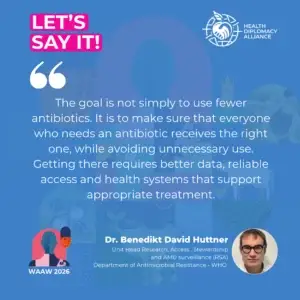
“The goal is not simply to use fewer antibiotics. It is to make sure that everyone who needs an antibiotic receives the right one, while avoiding unnecessary use. Getting there requires better data, reliable access and health systems that support appropriate treatment.”
By Dr. Benedikt David Huttner, Unit Head, Research, Access, Stewardship and AMU Surveillance (RSA)
Department of Antimicrobial Resistance – WHO
The 2024 Political Declaration set a target of 70% of human antibiotic use coming from the WHO Access group by 2030. What will it take for countries to reach it, and where is progress slowest?
The first thing we need is better data. We cannot really measure global progress towards the 70% Access target unless we have a much more complete picture of how antibiotics are being used globally. Participation in GLASS-AMU is increasing steadily with now over 100 countries enrolled, which is encouraging, but there are still important geographical gaps. Strengthening participation in GLASS-AMU therefore has to be one of the first steps.
From the data we do have, we know that reaching the target is possible. Around one third of countries reporting to GLASS-AMU already meet it. But in many countries, Watch antibiotics still account for too large a share of overall use.
At the same time, we need to keep in mind that a single target cannot capture the complexity of antibiotic use. A country could, for example, reach the 70% Access target and still have very high overall antibiotic use. We therefore need additional indicators and targets to guide national policies, looking at overall antibiotic use as well as other AWaRe-based measures. National averages can also hide considerable variation within countries, so where the data allow, we need to understand subnational patterns as well.
And changing prescribing patterns requires much more than asking prescribers to choose different antibiotics. Countries need national essential medicines lists aligned with the WHO EML and AWaRe system, procurement and reimbursement policies that support those choices, and treatment guidelines that make Access antibiotics (or no antibiotic care) the preferred option where appropriate. They also need reliable access to quality-assured essential antibiotics, effective regulation of antibiotic sales, trained health workers, appropriate diagnostics and functioning health systems.
Ultimately, I think it is useful to see the 70% target as an important marker of progress, rather than a complete measure of appropriate antibiotic use.
Since the AWaRe antibiotic book was published, what have you learned from how countries use it, and what would you change in the next update?
What has been particularly encouraging is the level of interest in the AWaRe antibiotic book and the different ways in which countries are using it. In some countries, the AWaRe antibiotic book has been translated and distributed, including Indonesia and Vietnam, and we also hear that it is being used in the education and training of healthcare workers.
That is important because the book was never intended simply to sit on a shelf as another WHO publication. Its value is in helping translate AWaRe into everyday clinical decisions, particularly when to use antibiotics (and when not to use them), which antibiotic to use, for which infection, at what dose and for how long. We are currently updating the book to align it with updated WHO recommendations, but we are also broadening its scope. The new version will include chapters covering all essential antibiotics and antifungals on the WHO Model List of Essential Medicines, with additional information on areas such as mechanisms of action and antimicrobial resistance. We hope this will make it not only a practical prescribing tool, but also a more useful educational resource for the next generation of healthcare workers.
One limitation is that we currently do not have the resources to systematically track how the book is being adopted and used across countries. That is something we would very much like to improve. A more systematic and comprehensive way of capturing uptake and feedback from countries, clinicians, teachers and students, including the barriers and enablers to using the book in practice, would help us understand what is working and what we should do differently in future updates.
Lack of access to antibiotics still kills more people than resistance in many settings. How can the Essential Medicines List and AWaRe help countries address access and excess use at the same time?
I think this is an important point, because antimicrobial stewardship is sometimes misunderstood as simply trying to reduce antibiotic use. It is not. Good stewardship means making sure that a patient who needs an antibiotic receives the right, quality-assured antibiotic, at the right time, at the right dose, by the right route, and for the right duration, while avoiding antibiotics when they are not needed. At the same time, ensuring access means that within a health system, an antibiotic is affordable, available, accessible and acceptable; of assured quality and safety; and is delivered and used appropriately. Stewardship is therefore an essential component of access.
The objective should not be “less antibiotic use” as such. It should be better antibiotic use, with assured access for everyone who needs antibiotics and no unnecessary exposure for those who do not.
This year’s theme is “One Health, one action”. If you could ask every sector to take one action now, what would it be?
The Essential Medicines List and AWaRe can help countries address both sides of that equation. They provide a basis for prioritising antibiotics that should be reliably available and affordable, while at the same time helping health systems use them appropriately and preserve the effectiveness of antibiotics that need to be used more selectively. Access, however, is not determined by a medicines list alone. Through the SECURE initiative, WHO and GARDP are working with countries to expand access to essential antibiotics while ensuring their appropriate use. SECURE helps countries build a quality-assured portfolio of antibiotics based on public health needs, including new antibiotics for drug-resistant infections as well as older essential antibiotics that are not widely available or are subject to frequent supply disruptions. The aim is to make these antibiotics available at an affordable price, for example through market-shaping approaches such as pooled procurement, and to support their appropriate introduction and use.

I would actually be slightly cautious about the idea that there is one action that will solve the problem. One of the clearest lessons from AMR is that isolated interventions tend to have limited impact.
Antibiotic innovation and stewardship, for example, will not achieve their full potential if we neglect infection prevention and control, vaccination, or water, sanitation and hygiene. Equally, asking clinicians to use antibiotics more precisely can be difficult if they do not have access to appropriate diagnostics.
But if I had to identify one priority around which different sectors could act, it would be improving antibiotic use. And I mean that in both directions: reducing unnecessary and inappropriate use, but also ensuring that people and animals who genuinely need antibiotics can receive the right treatment, while safeguarding these medicines across human, animal and plant health. That balance between access and appropriate use is fundamental to any sustainable response to AMR.

By Dr. Benedikt David Huttner
Unit Head, Research, Access, Stewardship and AMU Surveillance (RSA), Department of Antimicrobial Resistance , Health Systems, Access and Data (HSD) Division - Geneva, Switzerland