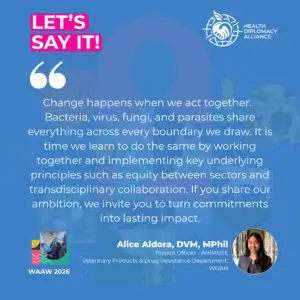
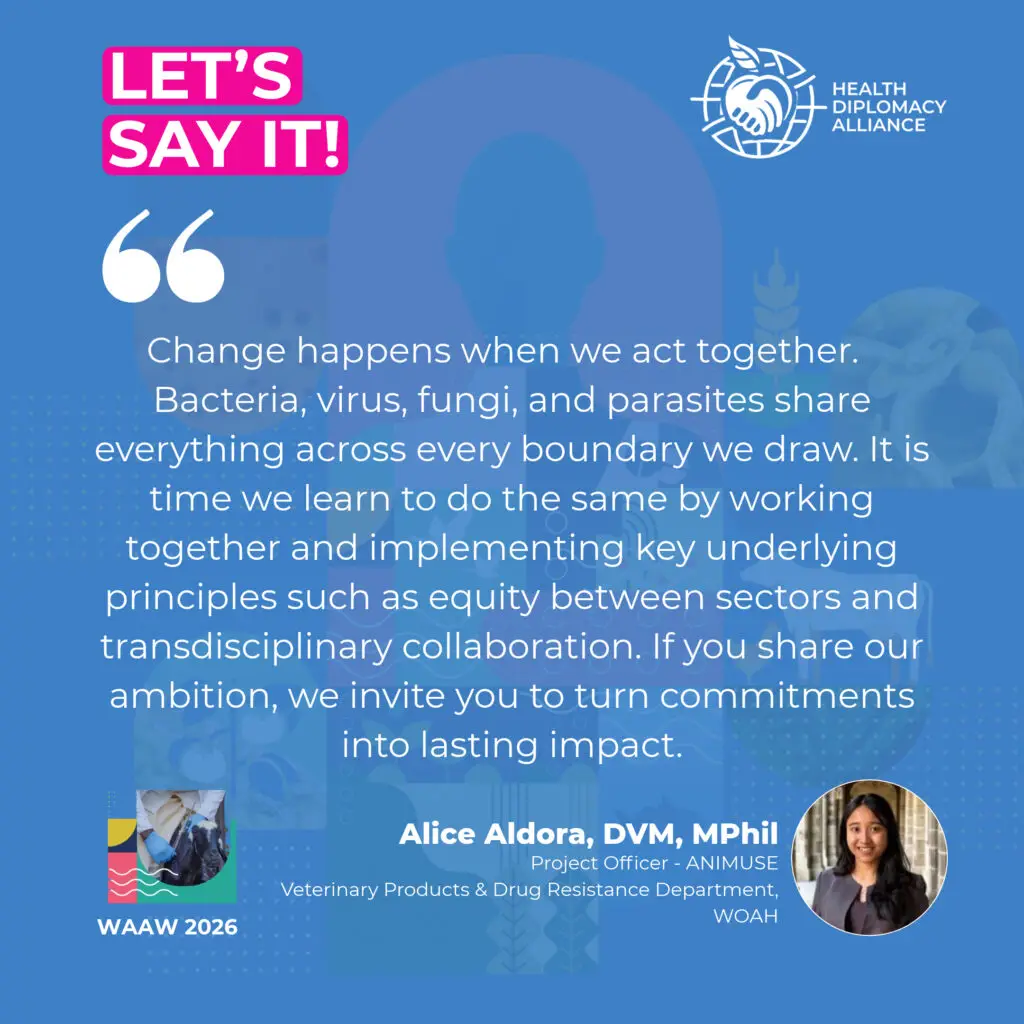


“Change happens when we act together.
Bacteria, virus, fungi, and parasites share everything across every boundary we draw. It is time we learn to do the same, by working together and implementing key underlying principles such as equity between sectors and transdisciplinary collaboration. If you share our ambition, we invite you to turn commitments into lasting impact.”
By the Veterinary Products & Drug Resistance (VPDR) Department, World Organisation for Animal Health (WOAH)
The updated Global Action Plan on AMR 2026 to 2036 sets targets across human, animal and environmental health. How will it shape WOAH’s priorities on AMR over the next three years?
The updated Global Action Plan 2026-2036 builds on the foundation established in 2015, but reflects an important evolution in the global response to AMR, putting a stronger emphasis on a comprehensive One Health approach encompassing human, animal, plant and environmental health. Built around six pillars, it perfectly blends with WOAH’s 2026-2030 vision on AMR, unveiled earlier this year during an event co-organised with the Organisation for Economic Co-operation and Development (OECD).
WOAH will focus on the prioritisation of prevention. That means understanding that animal welfare is an integral part of animal health, as the use of antimicrobials must never replace the presence of proper conditions in which animals are maintained or raised. That means understanding that biosecurity measures must be present all along the way, preventing the arrival and/or the spread of infectious diseases. That means understanding that animal vaccination is a powerful tool to reduce the need to use antimicrobials, and it must be considered as such when defining National Action Plans on AMR.
Our second priority seeks to generate authentic cross-sectoral collaboration, including identifying and funding priority needs for every sector, including animal health, ensuring the establishment of efficient cross-sectoral coordination mechanisms and implementing multi-sectoral National Action Plans on AMR.
Surveillance systems are to be seriously taken. Surveillance systems on AMR and AMU must be sustainably resourced and upgraded at the national level, with data shared across sectors and used to support decision-making under a One Health approach.
Lastly, we could not forget adequate funding. Sustaining existing and new funding mechanisms adapted to the needs of the different health sectors is essential, as well as ensuring they are proportionate to the actions planned, regardless of the specific sector involved. WOAH, in collaboration with its Quadripartite partners remain committed to support the implementation of cost effective interventions in all sectors, evidence-based, at global, regional and national levels. This is fully aligned with the strong, action-driven language of the updated GAP further supports countries in their continued efforts implementing of the existing strategic objectives and emphasises the need for strong multisectoral governance, sustainable financing and accountability under the new strategic objective (SO6).
Vaccines can reduce the need for antimicrobials in animals. How is WOAH approaching vaccination as part of its work on AMR, and where do you see the biggest opportunity and the biggest obstacle?
Vaccines are one of the most effective tools available to prevent disease and reduce the need for antimicrobials in animals. At WOAH, we see vaccination as a cornerstone of prevention, alongside good husbandry, biosecurity, surveillance and strong Veterinary Services.
The opportunity before us is to move from responding to disease outbreaks to preventing them in the first place. This ambition was reflected in WOAH’s Resolution No. 29, adopted by the World Assembly of Delegates, which called for stronger action on veterinary vaccines and vaccination, and in the commitments made in the 2024 United Nations General Assembly Political Declaration on AMR. WOAH helps its Members identify priority diseases where vaccination can reduce antibiotic use (the PROEVA initiative), develop guidance and tools, strengthen regulatory systems, and generate the evidence needed to support investment in prevention, and vaccination in particular.
The biggest opportunity is expanding access to vaccines that already exist. For several important livestock and aquaculture diseases, effective vaccines exist and have already helped reduce antibiotic use in well-resourced production systems. The biggest challenge is ensuring those vaccines are available, accessible and appropriately used where they are needed most. Many farmers, particularly in low- and middle-income countries, still face barriers linked to vaccine availability, affordability, delivery infrastructure, and the broader policies and services needed to support effective vaccination programmes.
Yet improving access is not simply a matter of producing more vaccines. In many countries, it can be difficult to accurately anticipate future vaccine needs, making it harder for manufacturers to plan production and investment. Regulatory approval processes can delay access to new or improved vaccines, while smaller or lower-income markets may not always attract sufficient commercial interest. In addition, governments, manufacturers, veterinarians and producers often work towards the same disease prevention goal, but without enough coordination to align priorities and plan effectively.
WOAH is helping foster this collaboration through initiatives such as its partnership with GALVmed and through the PREVENT Forum, which WOAH established to convene governments, industry and other stakeholders from across the vaccine ecosystem to identify practical solutions and accelerate progress towards prevention-focused animal health systems.
According to WOAH’s latest report, global antimicrobial use in animals decreased by 3% between 2019 and 2024. What does this progress tell us, and how can WOAH Members build on it to further reduce and optimise antimicrobial use and tackle AMR?
The 3% reduction in antimicrobial use between 2019 and 2024 for 80 participants is encouraging and shows that progress is possible. Although this trend is encouraging, a separate analysis not included in the latest report but available through the ANIMUSE Interactive Report, shows a 9% increase between 2018 and 2024 among a different group of 74 participants. These contrasting results show that progress is uneven and that a global decline cannot yet be assumed, calling into question our capacity to achieve the global reduction target set out in the 2024 United Nations Political Declaration on AMR. Additionally, reducing the total quantity used is only part of the picture. We must also look at how, why and which antimicrobials are being used.
One important priority, reinforced by the updated Global Action Plan, is to phase out the use of antimicrobials for growth promotion, particularly those classified as highest priority critically important antimicrobials for human medicine (HPCIA). These antimicrobials are essential for treating serious infections in humans, and their use for non-therapeutic purposes in animals should be progressively eliminated. Yet, nearly one in five WOAH Members continued to report the use of antimicrobials for growth promotion, highlighting the need for further action to align practices with WOAH standards and recommendations on responsible antimicrobial use.
We must also examine patterns of use. For example, even where overall antimicrobial use is declining, HPCIA still account for 6% of antimicrobial use in food-producing animals in 2024. This highlights why monitoring the classes and purposes of use is just as important as tracking total quantities. Through ANIMUSE, WOAH supports Members in monitoring these patterns and identifying where further action is needed.
There is also a strong economic case for action. WOAH and the World Bank’s economic modelling suggests that a 30% reduction in antimicrobial use in livestock over five years could generate a cumulative global GDP gain of approximately US$120 billion between 2025 and 2050. This demonstrates that responsible antimicrobial use is not only essential for tackling AMR, but also an investment in more sustainable and productive livestock systems.
WOAH stands ready to support Members in translating this monitoring data into evidence-based policies and action. This includes building capacity to analyse and report antimicrobial use data, as well as developing communication tools, such as policy-maker factsheets, to make findings more accessible to decision-makers. Through ANIMUSE, our aim is not simply to collect data, but to help Members use that evidence to identify priorities, guide interventions and monitor progress. Ultimately, surveillance is most valuable when it informs action.
Why should substandard and falsified veterinary antimicrobials be considered within national and global AMR action plans? Are substandard and falsified veterinary antimicrobials an overlooked driver of antimicrobial resistance?
Substandard and falsified veterinary products (SFVPs) represent a significant threat to animal health, food security, trade, national security and public health. Of particular concern are substandard and falsified antimicrobial products, which may contain inadequate amounts of active ingredients, incorrect formulations, or no active substance at all. Such products can result in treatment failure and expose pathogens to sub-therapeutic concentrations of antimicrobials, creating conditions that favour AMR emergence. Consequently, the prevention, detection and monitoring of SFVPs are increasingly recognised as essential components of global AMR mitigation efforts and the broader One Health agenda. WOAH has consistently highlighted the importance of ensuring access to quality-assured veterinary medicines to support antimicrobial stewardship.
Recognising the need for a coordinated global mechanism to address these risks, WOAH launched the Track and Report Unsafe VETerinary products (TRUVET) system in May 2026. TRUVET provides Members with a dedicated platform to report, monitor and manage incidents involving SFVPs, including for Members that may not yet have a national reporting system in place. Through systematic collection and analysis of incident data, TRUVET supports evidence-based regulatory action at the national level while enabling WOAH to monitor trends from regional and global perspectives, identify emerging threats and risk patterns, and issue alerts when necessary.
TRUVET has compiled data from 100 Members, include the one previously compiled during its pilot phase and generated valuable evidence on the scale of SFVPs affecting veterinary antimicrobials. Among reported incidents, SF antimicrobials represented the second most frequently reported category of veterinary products, representing more than 22% of all SFVP. Cases have been reported across all regions, including Europe, Asia, the Americas and Africa, demonstrating the global nature of the challenge. The antimicrobial classes most frequently implicated have been tetracyclines (27.08% products), aminopenicillins (13.19%) and sulfonamides (11.11%). Importantly, laboratory confirmation was unavailable in 41 of 122 investigated cases, while testing in others identified either the absence of the declared antimicrobial or concentrations below those stated on the label. These findings highlight gaps in capacity for laboratory testing of quality of veterinary products already on the market, and the potential for underdosing and treatment failure, both of which are recognised drivers of AMR and undermine antimicrobial stewardship efforts. Collectively, the data generated through TRUVET supports risk-based surveillance, regulatory strengthening and targeted interventions aimed at reducing the impact of SFVPs on animal health and preserving the effectiveness of veterinary antimicrobials.
How is WOAH strengthening regulatory systems for veterinary medicinal products to support the global fight against antimicrobial resistance (AMR)
WOAH has developed international standards, guidelines and recommendations that helps to ensure veterinary medicinal products including veterinary medicines, vaccines and diagnostic kits are safe, efficient and of good quality. These provide a foundation for strengthening national regulatory frameworks, promoting responsible antimicrobial use and contributes to the prevention of antimicrobial resistance (AMR).
Through its Terrestrial and Aquatic Manuals, WOAH provides internationally recognised standards and guidance for the validation and use of veterinary diagnostic tests, to ensure their accuracy, reliability and fitness for purpose.
WOAH is also working to strengthen regulatory harmonisation and improve access to reliable veterinary diagnostic kits. As part of these efforts, WOAH is reviewing its diagnostic kits registration framework, exploring approaches to streamline diagnostic kits recognition procedures, establish minimum criteria for reliable registration and facilitate access to quality diagnostic kits for Members irrespective of their regulatory capacity.
By strengthening regulatory frameworks and improving access to reliable veterinary diagnostic kits, WOAH supports its Members in promoting animal health and addressing antimicrobial resistance.
Aquaculture is a relatively small industry compared to other food–producing sectors. Should the role of aquaculture on antimicrobial stewardship be considered significant when addressing antimicrobial resistance under the One Health approach?
Although aquaculture is smaller in scale than other food-producing sectors, it is the fastest-growing one, with an average annual global growth rate of 5% over the period 2000–2024, according to the latest FAO report on fisheries and aquaculture production. This growth is expected to continue, driven by a growing human population and increasing demand for high-quality protein sources.
Regarding antimicrobial use, the latest data available in WOAH’s ANIMUSE database indicate that, in 2024, aquaculture accounted for 2.3% of the total quantity of antimicrobials intended for use in animals. While this may seem relatively small, it represents more than 1,500 tonnes of antimicrobials. In aquaculture, antimicrobials are mainly administered through medicated feed, which can result in their direct release into the aquatic environment during treatment. This occurs in inland closed or semi-closed systems, such as tanks and raceways, as well as in open or semi-open systems in lakes and marine waters, such as pens and floating cages. Following antimicrobial administration, uneaten medicated feed and antimicrobial residues excreted by treated animals enter the water column and eventually accumulate in sediments. It has been estimated that up to 80% of administered antimicrobials may end up in the aquatic environment, potentially resulting in a considerable environmental impact.
Furthermore, some antimicrobials used in aquaculture belong to the category of highest-priority critically important antimicrobials for human medicine, as defined by WHO. Fluoroquinolones, which fall within this category, accounted for 17% of total antimicrobial use in aquaculture in 2024, ranking fourth among the most widely used antimicrobial classes in the sector, based on quantities reported in ANIMUSE.
It is important to highlight that, although aquaculture can contribute to the dissemination of antimicrobial-resistant bacteria, antimicrobial resistance determinants and antimicrobial residues into the aquatic environment, other sectors also make significant contributions through the discharge of untreated effluents containing residues of antimicrobials used in human medicine and agricultural run-off into water bodies. Given the interconnectedness of these sectors through the aquatic environment, each remains vulnerable to, and to some extent dependent on, how antimicrobials are used and managed in other sectors (as illustrated in Figure 1 of the accompanying article).
This is why aquaculture is an essential piece of the broader One Health framework and must be explicitly considered in National Action Plans on AMR to ensure a comprehensive approach to antimicrobial stewardship. Addressing the specific conditions and characteristics of aquaculture through measures adapted to the individual context of each WOAH Member’s sector is imperative to effectively address AMR.
This includes, among other things, establishing effective antimicrobial use monitoring systems that encompass aquaculture incorporating data from national sales records and/or field-level use; implementing good husbandry practices and biosecurity measures (as outlined in WOAH guides for professionals and producers); and promoting the uptake of alternatives to antimicrobials, such as the initiative undertaken by WOAH under the Reasons project.
This year’s theme is “One Health, one action”. What is WOAH call for action?
Our call to action is simple: turn commitments into meaningful action. Every sector must take responsibility for its contribution to tackling AMR, recognising that progress in one sector can help protect health across all sectors.
Meet the VPDR Team
Head of Department
Senior Scientific Coordinator

Program Officer - Vaccines and Vaccination

Senior Data Management Officer
Programme Manager

Project Officer - ANIMUSE

Senior Programme Manager

Project Officer – Substandard and Falsified Veterinary Product

Project Officer - Regulatory Systems for Veterinary Products
Scientific Coordinator

Administrative Officer
Connect with the team: vpdr.dept@woah.org