Speakers and Facilitators:
Dr. Jacqueline Kitulu – President, World Medical Association
Emma Rawson-Te Patu – President, World Federation of Public Health Associations; Expert Member, United Nations Permanent Forum on Indigenous Issues
Dr. Valeria Gigante – Lead, R&D and Innovation for Antimicrobial Resistance (AMR), World Health Organization
Dr. Caline Mattar – Professor of Medicine and Public Health; Infectious Diseases Specialist
Abigail Corrao – Adjunct Professor, Georgetown University; Co-Founder, Global Health Governance as Public Service
Dr. Paula Reges – Advisor, Global Health, Pasteur Network
Arantxa Cedillo – Founder, Arctype®; Senior Strategic Communications Advisor, Health Diplomacy Alliance
Haadiya Ahmed – Global Health Governance Fellow, Health Diplomacy Alliance
Ms. Katherine Urbáez, Executive Director of the Health Diplomacy Alliance
Main Discussion
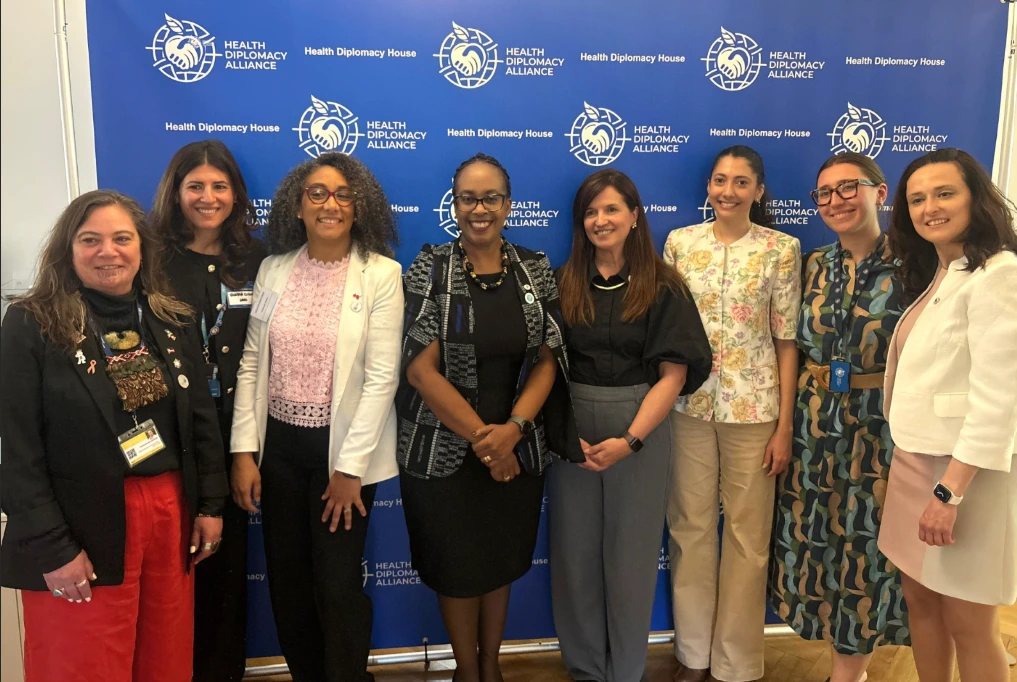
On May 21, 2026, the Health Diplomacy Alliance convened the session Women at the Heart of Health Diplomacy. Heal, Lead, Seal as part of Health Diplomacy House on the sidelines of the 79th World Health Assembly in Geneva. The discussion brought together women leaders, diplomats, researchers, advocates, and public health professionals for an open and intergenerational exchange on leadership, representation, and influence in global health diplomacy. Framed around the realities of decision-making from community settings to multilateral negotiations, the session explored the persistent gaps that continue to limit women’s participation and authority in health governance. Through personal reflections and professional experiences, speakers highlighted the value of diverse perspectives in strengthening diplomacy and advancing more equitable health outcomes across regions and institutions.
The conversation underscored that women continue to face structural, institutional, and cultural barriers that restrict their ability to shape high-level health decisions. Participants reflected on moments where women’s voices were absent from negotiation tables and the consequences this had for policy, implementation, and communities. Attention was given to the experiences of young women entering the field, alongside the lessons and resilience of senior women who have spent decades navigating complex political and diplomatic environments. Speakers emphasized that meaningful progress requires more than symbolic representation. It demands systems that value lived experience, intersectional identities, and different forms of leadership. The discussion also highlighted the importance of mentorship, coalition building, sponsorship, and male allyship as practical approaches to creating more inclusive and responsive institutions.
The session concluded with a strong call to move from commitments on inclusion to tangible shifts in power. Participants encouraged governments, international organizations, academic institutions, funders, and civil society to invest in leadership pathways for women, strengthen gender responsive negotiation processes, and create spaces where women can contribute fully without needing to justify their presence. There was broad agreement that the future of health diplomacy depends on embracing diverse leadership and fostering collaboration across generations, sectors, and regions. More than a conversation, the session reinforced that women are already shaping global health diplomacy through expertise, innovation, and partnership. Their leadership is not an aspiration for the future but an essential force for building stronger negotiations, more equitable policies, and healthier societies worldwide.
Organizer
Main Organizer
Health Diplomacy Alliance