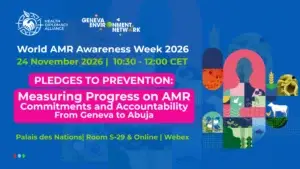
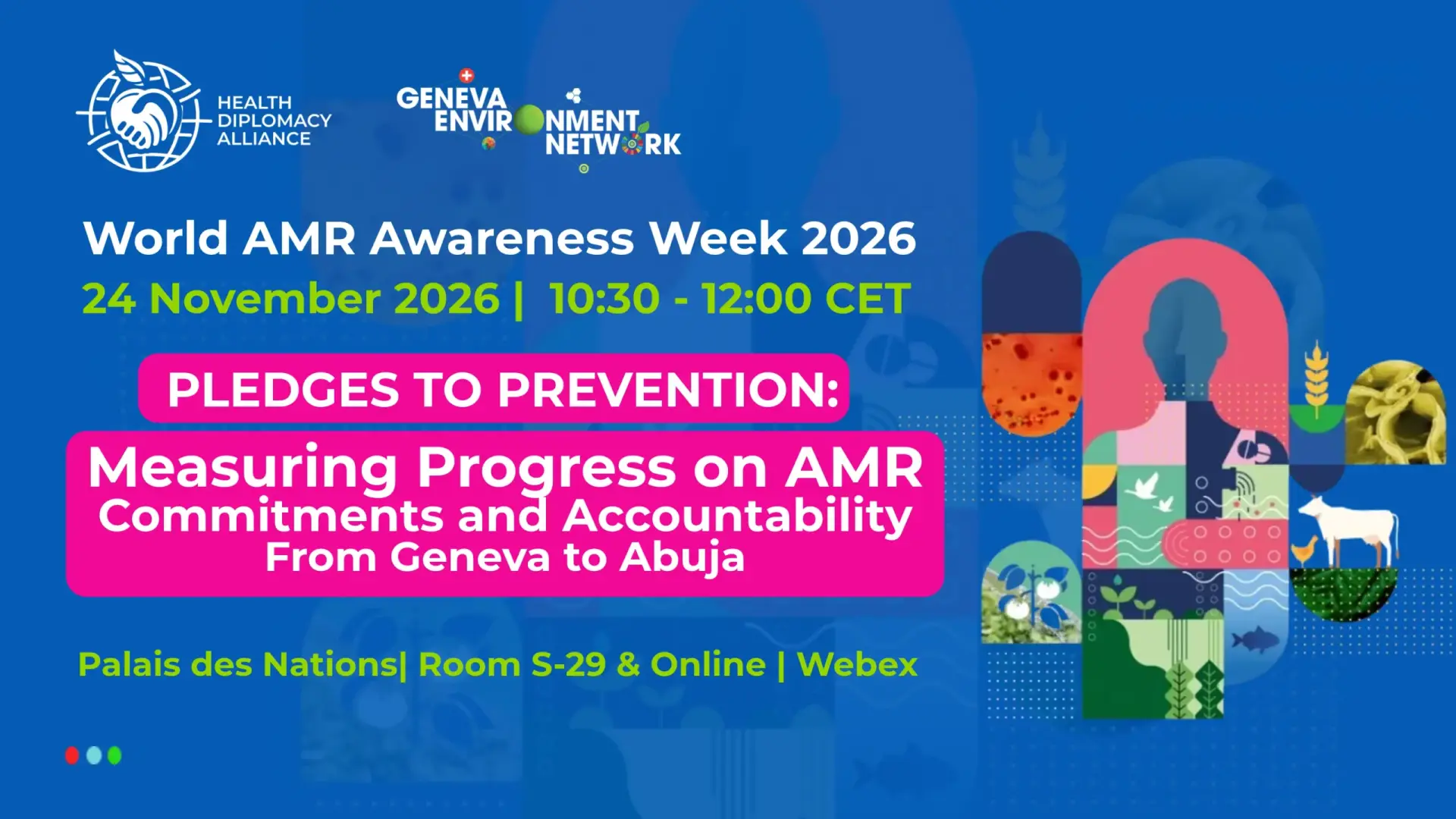
Held on the final day of the 2026 World Antimicrobial Awareness Week, this event will bring together experts and policymakers to examine the journey from pledges to prevention, assessing commitments made under the 2024 UN Political Declaration on AMR against the evidence on effective prevention and accountability. The discussion will explore how global commitments are being translated into action with a particular focus on prevention measures, and what more is needed to accelerate progress toward the 2030 AMR targets.
About the event
Antimicrobial resistance (AMR) occurs when bacteria, viruses, fungi and parasites no longer respond to the medicines designed to treat them. As resistance grows, infections become harder, and sometimes impossible, to treat. AMR is already a major global threat, increasing pressure on health systems, food security, economies and sustainable development, particularly in countries with limited resources.
Recognizing the scale and urgency of this challenge, world leaders adopted the 2024 UN Political Declaration on AMR, committing to a One Health response and agreeing on targets for 2030, including a 10% reduction in deaths associated with bacterial AMR compared with the 2019 baseline. They also agreed to establish an independent panel on evidence for action against AMR. Two years later, key questions remain: What does the evidence show works to prevent AMR? And are governments translating that evidence into action?
While the global policy framework is now in place, delivering on these commitments depends on the effective implementation of proven prevention measures. These include infection prevention and control, water, sanitation and hygiene (WASH), vaccination, responsible antimicrobial use in human, animal and plant health, and action to reduce environmental contamination from antimicrobial residues, resistant microorganisms and other pollutants. Measures such as pollution prevention at source, improved waste and wastewater management, and stronger regulation of environmental releases can help limit the emergence and spread of resistance across ecosystems. Yet implementation remains uneven, and the strength of the evidence base varies across sectors. What is holding progress back? Where are successful approaches being implemented, and what barriers prevent health, agriculture, veterinary and environmental actors from scaling them up through a coordinated One Health approach?
Among these prevention efforts, the role of the environment has emerged as an increasingly important area of attention and action. The UNEA Resolution 7/11 on the environmental dimensions of AMR, together with the joint Quadripartite efforts of FAO, UNEP, WHO and WOAH, underscore that preventing AMR requires action across health, agrifood and environmental systems. Pollution, chemicals and waste management, wastewater treatment, ecosystem health, and sustainable production practices all have a role to play alongside health-sector interventions. This direction is reinforced in the updated Global Action Plan on AMR 2026-2036, which recognizes environmental dimensions as insufficiently addressed, calls for environmental interventions to be fully integrated into national AMR responses, and places pollution prevention within a prevention-first One Health framework.
This growing recognition of shared responsibilities across sectors is reflected in World Antimicrobial Awareness Week (WAAW) 2026, held from 18 to 24 November under the theme “One Health, One Action: Prevent AMR Now”, highlights this shared responsibility. Governments, health professionals, veterinarians, environmental authorities, farmers, researchers, industry and communities all have a role in preventing AMR. Moving from commitments to implementation will require coordinated action across sectors, informed by science, guided by accountability and focused on prevention.
The discussion is also relevant in preparation for the Ministerial Conference on Antimicrobial Resistance in Abuja in December 2026, where governments will review progress and consider the next steps for implementing global AMR commitments and the launched of the Independent Panel for Evidence for Action against. Antimicrobial Resistance (IPEA).
Participation
In-Person Registration
This event will take place at the Palais des Nations. To attend in person, kindly register on Indico.
Organized By
United Nations Environment Programme
Health Diplomacy Alliance