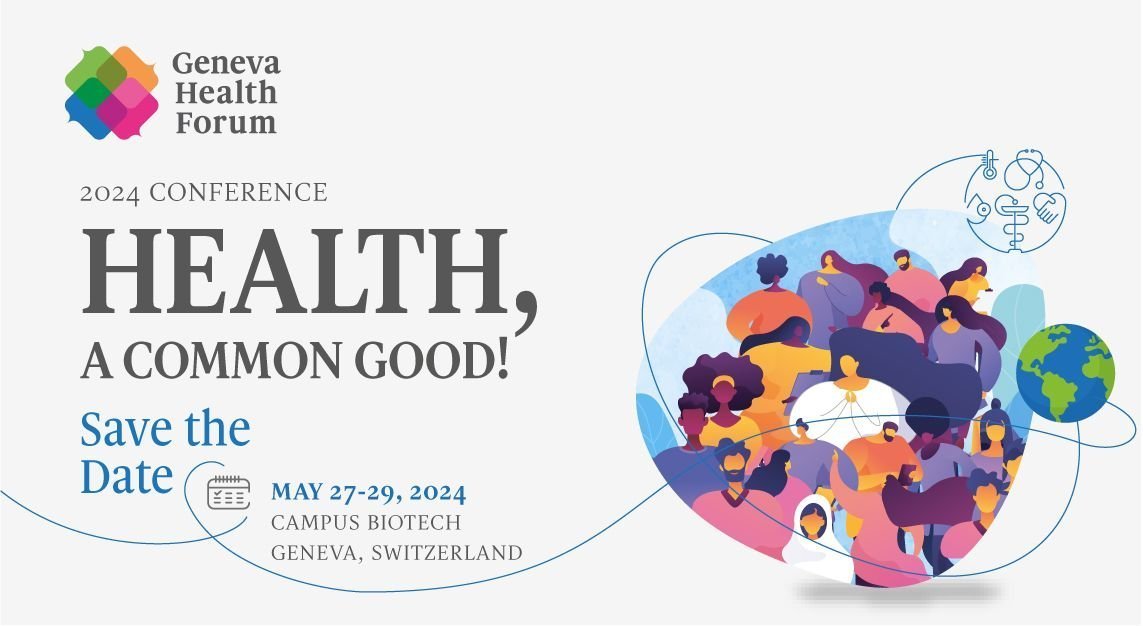
🌍 The Geneva Health Forum 2024 Conference: Health, a Common Good!
🗓 May 27-29, 2024
📍 Campus Biotech, Chemin des Mines 9, 1202 Geneva
The Geneva Health Forum 2024 to be celebrated from May 27-29 is prepared to convene global health leaders, researchers, medical practitioners, field actors, and policymakers for a transformative conversation on challenges and solutions toward health equity and access.
The ever-growing disparities in health outcomes worldwide underscore the limitations of relying solely on market mechanisms to ensure equitable access to healthcare. The Conference theme \”Health, a common good!\” reaffirms the importance of viewing health as a collective asset, requiring collaborative efforts, community engagement, and a broader focus on the social and environmental determinants of health.
The 2024 GHF Conference will delve into the vision of health as a common good across three pivotal domains:
1. Health and the Environment: Time for Solutions
2. Migration, Health, and Equity
3. Towards the Elimination of Malaria
The Geneva Health Forum will serve as a platform for experts, researchers, and practitioners to collaborate, share insights, and advance solutions in these key areas.


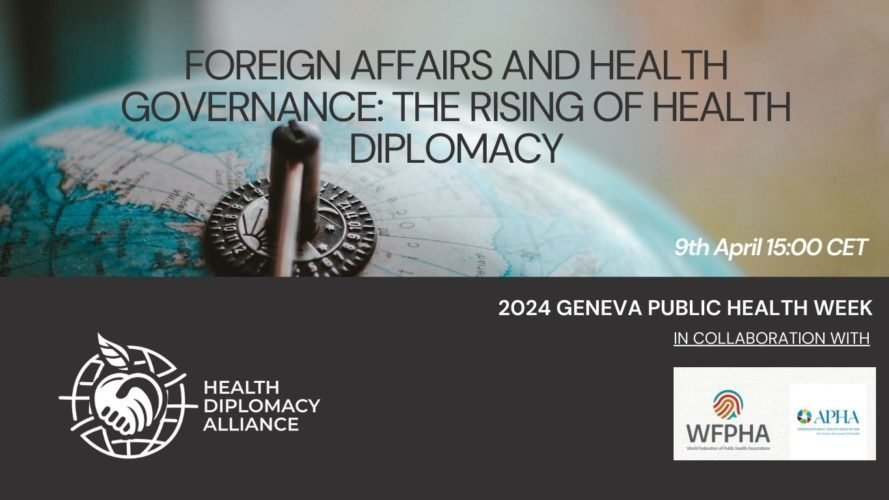
by Katherine Urbáez, MSc (Health Diplomacy Alliance) and Ramón Anulfo López, MD (American Public Health Association)
In the waggle dance of international relations, where power dynamics, geopolitical interests, and diplomatic finesse often take center stage, there’s a growing recognition of the pivotal role played by health governance. This is not confined to public health but extends far beyond, permeating foreign policy, diplomacy, and global security. As the world grapples with an array of polycrises—including health and environmental challenges — from pandemics to AMR, climate change, conflicts, and humanitarian crises, the fusion of health and diplomacy has become increasingly imperative.
At the heart of this nexus, health diplomacy has morphed into a multifaceted “approach” that integrates current health concerns into diplomatic strategies, leveraging them to foster cooperation, resolve conflicts, and advance national interests. Recent developments underscore the growing prominence of health diplomacy on the global stage, as evidenced by concerted efforts to address pressing health issues through diplomatic channels.
Employing health diplomacy has played a significant role in advancing advocacy for critical health issues, such as the fight against HIV/aids, malaria, tuberculosis, polio eradication, and mental health. For instance, various countries have collaborated through diplomatic channels to secure funding and resources for the prevention and control of disease, technology transfer, access to medicine, and others, facilitating the allocation of essential resources and fostering partnerships and cooperation among stakeholders.
In this regard, one of the most significant milestones is the initiative to negotiate the world’s first pandemic agreement and the revision of the IHR. Against the backdrop of the COVID-19 pandemic, which exposed glaring gaps in public health, Member States decided to negotiate a groundbreaking accord to “safeguard” global health security. However, the current negotiation process has encountered several roadblocks, reflecting the complexity and challenges of addressing health issues diplomatically.
One of the critical issues is the need for explicit provisions safeguarding the rights and well-being of health and care workers. These frontline workers have been instrumental in the response to the COVID-19 pandemic. Furthermore, the negotiation process should also bring to the fore and address the underlying structural inequalities and inequities that exacerbate vulnerability during the pandemic—ensuring equitable access to vaccines, treatments, and other essential health technologies—in unity with addressing unsolved, long-standing social determinants of health such as poverty, discrimination, and lack of access to healthcare.
Failure to adequately address these issues could undermine the effectiveness and legitimacy of the pandemic accord, highlighting the need for inclusive and transparent negotiations that prioritize the interests and well-being of all stakeholders, particularly the most vulnerable and marginalized communities.
Similarly, health diplomacy is latent for advancing discussions on integrating the One Health approach — the interconnectedness of human, animal, and environmental health — within the context of pandemic preparedness and response. As talks progress, stakeholders are deliberating on ways to operationalize One Health principles, which are not new for many Member States but conflicting in practicality and policy implementation by others. By incorporating One Health into the pandemic accord, policymakers seek to enhance health systems’ resilience, mitigate the risk of future pandemics, and address complex health challenges effectively; therefore, aligning their needs with those recommendations and guidance from the Quadripartite organizations is a challenge to centralize into the best ‘Approach.’
Leaders call for scale-up in implementing the One Health approach
Adopting a One Health approach that recognizes the health of people is closely connected to the health of animals and…
www.who.int
Moreover, the political dimension of the health crisis has become a sharp focus, particularly in conflict-affected regions like Gaza. The recent deaths of humanitarian workers in Gaza have prompted the WHO to demand a deconfliction mechanism for relief missions, accentuating a call for more outstanding diplomatic efforts to ensure the safety and security of workers operating in volatile environments.

In the face of other mounting crises, AMR also poses an escalating concern, where the intersection of health diplomacy and politics has become increasingly crucial. The Global Leaders Group, chaired by Barbados Prime Minister Mia Amor Mottle, has recently published the ten recommendations for consideration by UN Member States in the outcome document of the High-level Meeting on AMR scheduled to take place in New York on September 20, 2024, where urgent political and decisive actions are pivotal to defying the mounting menace of AMR.

At the forefront of these endeavors is WHO, whose role as the leading global health organization is increasingly prominent in diplomacy. From brokering international agreements to coordinating emergency responses, WHO plays a pivotal role in shaping the global health agenda and fostering cooperation among nations. However, the effectiveness of WHO’s diplomatic endeavors hinges on institutional leadership\’s active engagement with Member States, accepting the role of communities, civil society, and other stakeholders, and advocating for financial and sustainable investment to ensure its goals.
Resources
The WHO Council on the Economics of Health For All aims to reframe health for all as a public policy objective, and…
www.who.int
Indeed, the success of health diplomacy ultimately depends on building trust, fostering dialogue, and forging partnerships across borders and sectors. In an era marked by growing interdependence and shared vulnerabilities, the imperative for health diplomacy has never been more apparent. The complex terrain of global health governance — with its technical, scientific, and political challenges — must recognize the inseparable link between foreign affairs and health and embrace diplomacy as a powerful tool for advancing Health for All.
The rising prominence of health diplomacy reflects a paradigm shift in global governance, where health considerations are increasingly recognized as integral to foreign policy and international relations. From pandemic preparedness to antimicrobial resistance, from communicable and non-communicable diseases, the intersection of health and diplomacy offers immeasurable opportunities for cooperation, conflict resolution, and collective action to embrace political will and effective policy implementation. As we face an array of enormous health challenges, harnessing the power of health diplomacy is a strategic and moral imperative for safeguarding the health and well-being of ALL.
World Health Day 2024
The theme for World Health Day 2024, celebrated on 7 April, is \’My health, my right\’. It was chosen to champion the…
www.who.int
AMR (antimicrobial resistance)
IHR (International Health Regulation)
WHO (World Health Organization)
FAO (Food and Agriculture Organization)
WOAH (World Organisation for Animal Health)
UNEP: United Nations Environment Programme
Quadripartite Organizations (WHO, FAO, WOAH, UNEP)