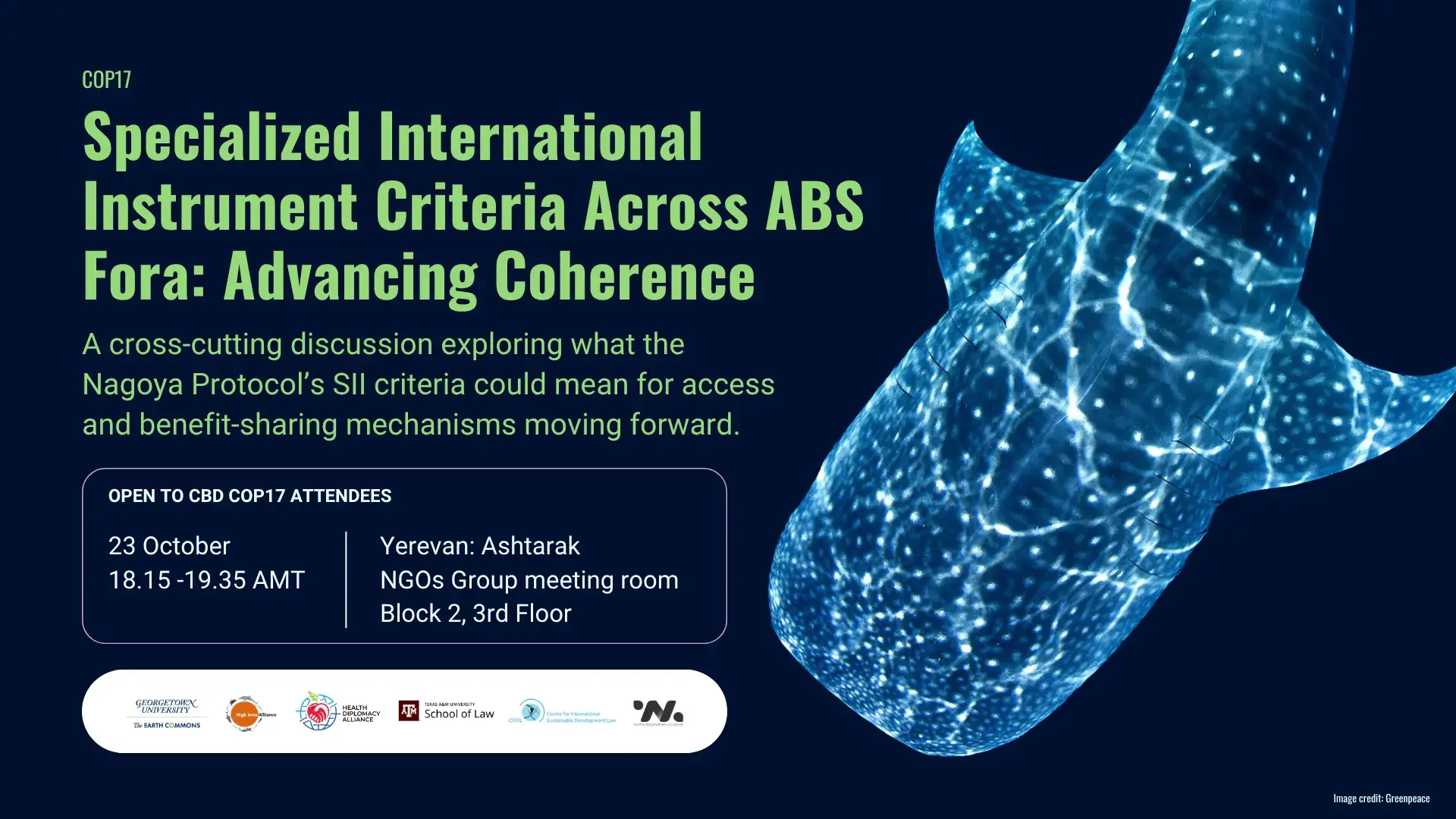
This month, at COP17, countries are expected to agree on criteria to decide what counts as a “specialized international instrument” (SII) under Article 4.4 of the Nagoya Protocol.
Since the Protocol was adopted, questions remain if other access and benefit-sharing systems can be a model or a reference point for these SII criteria. These systems include:
- Multilateral System under the International Treaty on Plant Genetic Resources for Food and Agriculture
- World Intellectual Property Organization Treaty on Intellectual Property, Genetic Resources and Associated Traditional Knowledge
- Pathogen Access and Benefit-Sharing System under the WHO Pandemic Agreement
- System for marine genetic resources under the Biodiversity Beyond National Jurisdiction (BBNJ) Agreement
This is a debate-style session. Experts from each system will explain why their system should be a standard for SII guidance under the Nagoya Protocol.
The session aims to discuss some of the most challenging aspect of the second week of the Nagoya Protocol talks. It also aims to impact the Intergovernmental Working Group for the WHO Pandemic Agreement and the first Conference of the Parties to the BBNJ Agreement. Both may need to look at how the new SII criteria work with their own legal frameworks and duties, and to be clear about the scope of each system.