The global health architecture is currently undergoing significant institutional change, with several parallel reform initiatives underway, including UN80, the WHO Joint Process, and other financing processes. At the same time, climate change is increasingly shaping health risks, health-system resilience, and the broader conditions in which health policy is made and implemented.
@Health Diplomacy Alliance
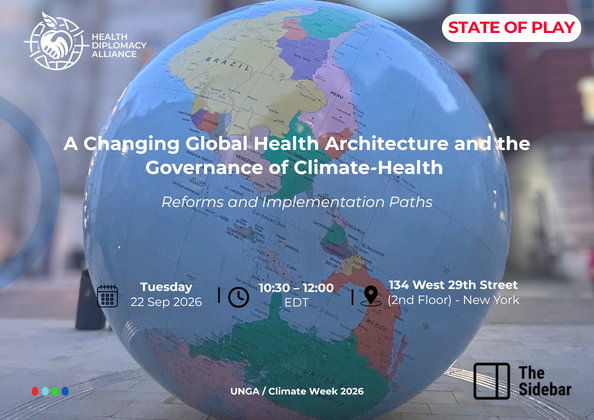
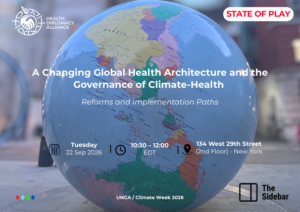
On the sidelines of the 81st UN General Assembly, the Health Diplomacy Alliance hosted “A Changing Global Architecture and the Governance of Climate-Health,” an informal, interactive discussion to examine where these reform processes currently stand and whether the changing global health architecture is well positioned to govern and deliver climate-health action. The session helped map the relationship between institutional reform and implementation, including where responsibilities sit, and fed directly into the Alliance’s reform tracking initiative, The State of Play.
Several themes emerged from this discussion. First,climate and health governance operate on siloed tracks, yet both reform processes face shared challenges of fragmentation and financing. Diversification of financial streams is a priority for Member States across health and climate agendas, where linkages between national, regional, and multilateral steams, as well as both private and public financing sources, are being made. In this context, it doesremain unclear whether the current wave of GHA reform is drivenby fiscal constraint in the multilateral system or by a shared vision of health sovereignty and climate-health integration.
Second, reformprocesses are relatively still in the design phase. For these processesto move beyond theoretical frameworks, they must beinformed by technical evidenceandconsultative with diverse stakeholders. Specifically, including parliamentarians, women, youth, and local communities to monitor transition plans and hold governments accountable.While in the design phase, attention should be paid to whether processes are equitable, accountable, and transparent in operation.
The discussion closed on a shared point: reform should return to basics, set clear goals adapted to national contexts, and be judged by whether countries are able to deliver on health and climate priorities at the locallevel.
@Health Diplomacy Alliance
Organizers
Health Diplomacy Alliance
The Sidebar
Dr Satoshi Ezoe
Senior Assistant Minister for Global Health, Ministry of Health, Labour and Welfare (MHLW), Japan
Dr Flavia Bustreo
Former WHO Assistant Director-General | GWL Voices | Vice-Chair, Foundation Botnar | Co-Chair, Lancet Commission on GBV
Dr Paula Reges
Presidential Advisor for International Affairs
Fundação Oswaldo Cruz – Fiocruz
Dr Jérôme Weinbach
Deputy director for European and International Affairs of the French Social Ministries